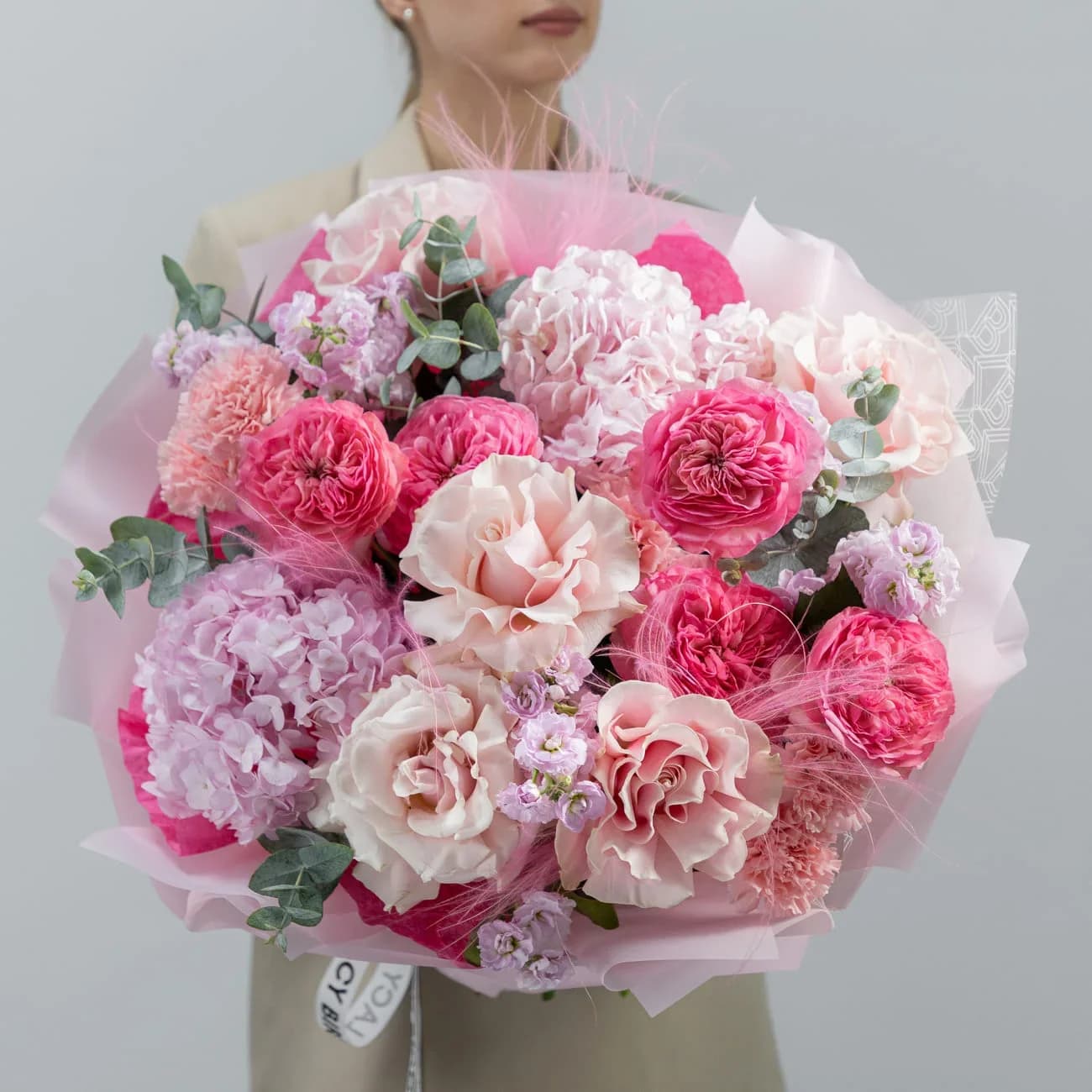
Floral Design Course — Modern Floral Design by Lacy Bird
A professional online floral design course built by working florists — palette, shape, and the commercial discipline of modern floristry. 12 hours of video, personal feedback, lifetime access, in English.
This is an online floral design course built by working florists, taught in the design language we've spent 13 years developing at Lacy Bird — a language now known as modern floral design. Soft palettes, generous but disciplined shapes, restraint over ornament, movement over symmetry. Applied every day in a commercial flower studio, not on a hobbyist's kitchen table.
The course covers the full working system end to end: twelve hours of recorded classes, personal feedback from working florists, and lifetime access to every module. In English. Delivered by Lacy Bird Academy.
Enroll on academy.lacybird.comWhat is "modern floral design"
For most of floral history, "designed" flowers meant one of two things: dense Victorian round bouquets built around a single dominant bloom, or the tight, geometric arrangements of European ceremony floristry — foam-based, symmetrical, theatrical.
Modern floral design is the counter-argument. It borrows more from fashion, interior design, and Dutch Old Master painting than from the traditional florist's manual:
- Palette before flower. The colour story is chosen first — muted blush, bruised burgundy, sun-bleached cream — and the flowers are selected to serve it.
- Movement over symmetry. Stems arch, cascade, or fall deliberately across the front. Nothing is centred, nothing is forced.
- Negative space is a material. Emptiness is designed, not left over.
- Texture is layered. Not five roses; a rose, a scented geranium leaf, a clematis vine, a spray of hellebore.
- Commercial discipline. Every design has to price out, transport, photograph, and last. Beautiful is table stakes — practical is the actual skill.
You know a modern arrangement when you see one on Instagram. What most florists don't have is the working system behind it: how to price it, buy for it, build it in fifteen minutes on a wedding morning, and photograph it well enough to book the next client.

Who this course is for
Complete beginners. No prior floristry experience needed. The first modules start from the mechanics of a stem — cutting, conditioning, wiring, taping — and work forward.
Working florists who want to modernise. You already know how to build a biedermeier. This course gives you the design language and the commercial system to sell a different kind of work at a higher margin.
Career changers. People coming from adjacent fields — event planning, interior styling, photography, wedding coordination — who want to add professional floristry to their toolkit.
Studio owners hiring florists. Several graduates use the course as a training curriculum for their own new hires — the vocabulary and technique transfer directly.
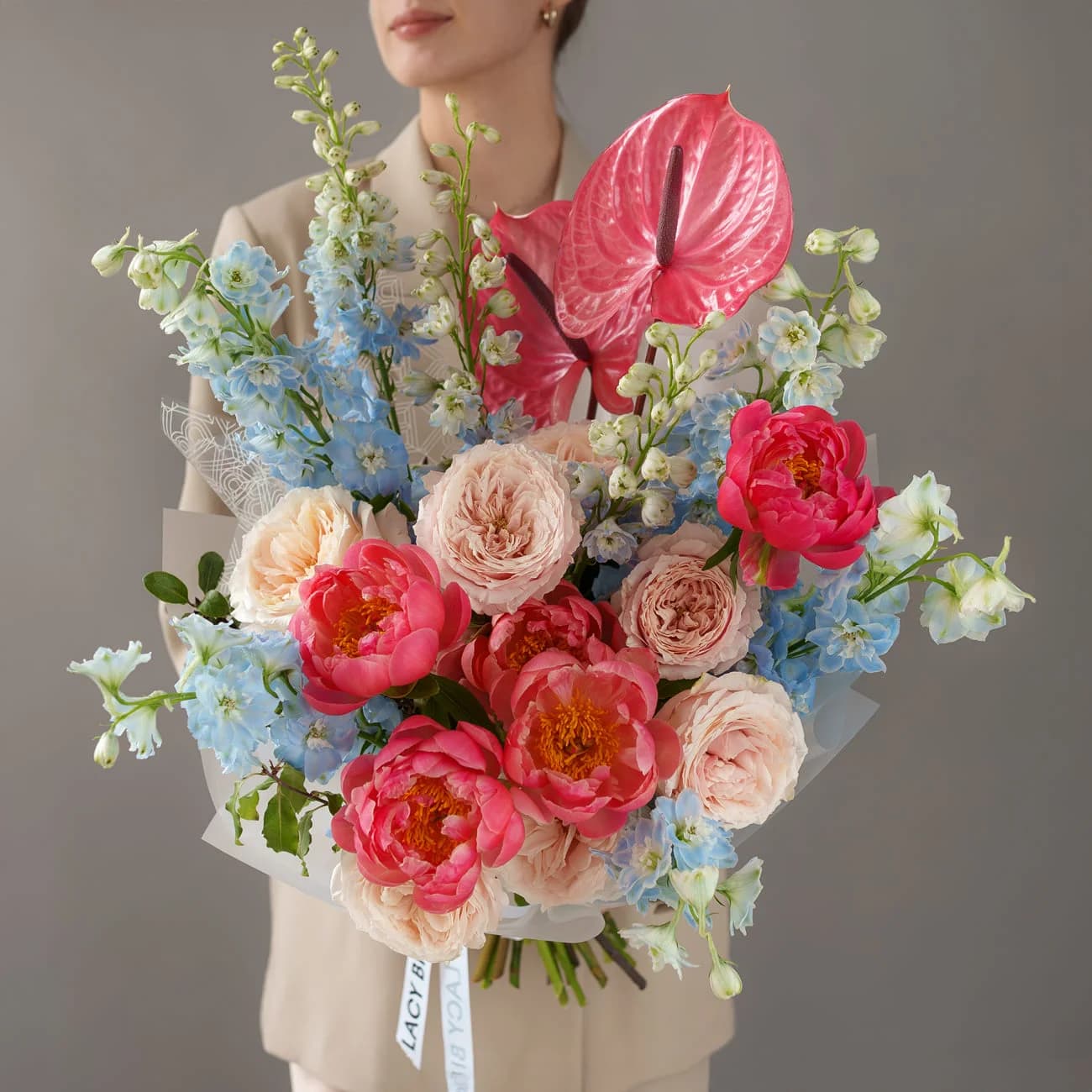
What our floral design course covers
Twelve hours of recorded classes across four levels. Each module includes a detailed video, a written recipe (formula + supplier list), and a submission step where a working florist reviews your work.
1 · Fundamentals (2h)
The mechanics that make the rest possible. Stem preparation, conditioning protocols that actually extend commercial vase life, wiring techniques used in bridal work, foam-free construction with grid taping and chicken wire, colour theory applied to real flowers, and the anatomy of a designed arrangement — mass, line, focal, filler.
2 · The hand-tied bouquet (3h)
Our signature bouquet, built five ways: garden-style, cascading, structured, compote-style, and bridal. The spiral technique that lets you assemble a 50-stem bouquet in under fifteen minutes. Wrapping, ribboning, and finishing.
3 · Wedding and event work (4h)
Where the money is, and where the technique is hardest. Bridal bouquets, bridesmaid bouquets, boutonnières, ceremony installations (arches, aisles, altars), reception centrepieces (tall, low, and elevated), and the production system — recipes, quantities, transport, setup, teardown — that makes a full wedding runnable by one senior florist and one assistant.
4 · The business of modern floristry (3h)
The module most floristry courses skip. Pricing (the four-times rule, when it works and when it lies), sourcing (wholesalers, specialty growers, farmer partnerships), studio layout, portfolio-building, Instagram strategy for florists, and the client conversation — how to sell your design language rather than a shopping list of stems.
Who teaches it
The course is built and led by Sofya Veyber, who founded Lacy Bird in 2012 and shaped what modern floral design became within our studio. Additional modules are taught by our senior florists — Oksana Anikina (current head of style) and Daria Shulzenko (academy curator, who teaches the majority of our programmes).
All three are working florists — running weddings, events, and daily studio production alongside their teaching. Nothing in the course is theoretical.

Format and access
- 12 hours of recorded video across roughly 40 lessons
- English language, subtitled
- Lifetime access — buy once, come back anytime
- Personal feedback: submit your work, get reviewed by a working florist
- Certificate on completion
- Money-back guarantee within 14 days if the course isn't right for you
The course runs at your pace — no cohort, no start date. Most students complete it in six to twelve weeks working on weekends.
What you'll leave with
- A repeatable design system you can apply to any brief — bridal, event, daily delivery, editorial.
- A pricing model that survives contact with real clients.
- A portfolio-ready set of ten to fifteen finished arrangements.
- A supplier and wholesaler reference for building your own sourcing network.
- Membership in the alumni group — 12,000+ florists across three continents.
Frequently asked questions
Do I need to be based somewhere specific?
No. The course is online, in English, and works from any country. Recipes name common commercial flowers rather than obscure regional varieties, and we suggest substitutes where relevant.
What supplies do I need?
A working knife, floral scissors, stem strippers, floral tape, wire in several gauges, and flowers. We publish a supplier list for the US, UK, EU, UAE, and Latin America. Weekly module lists tell you exactly what to buy.
How much time per week?
Most students spend three to five hours per week — one longer session to watch the module and complete the exercise, plus a shorter session for feedback and iteration. Completion in eight to twelve weeks is typical.
Is this a hobby course or a career course?
Both work. The fundamentals and hand-tied modules are accessible to complete beginners; the wedding-and-event and business modules are the ones that convert graduates into working commercial florists.
Will I get a certificate?
Yes. On completion of all modules and the final portfolio submission, you receive a Lacy Bird Academy certificate. It is not an academic accreditation (no floristry authority in the world reliably provides one), but it is recognised by our alumni network and by the studios where our graduates work.
Can I take this if I already work as a florist?
Yes — a significant share of our students are working florists updating their style. If you already know the mechanics, skip the fundamentals module and start with the hand-tied bouquet or wedding work.
Do you offer refunds?
Yes. If you decide the course isn't right for you within fourteen days of purchase, we refund in full — no questions.
What about in-person training?
We run in-person masterclasses in Dubai, Rome, Amsterdam, Bucharest, and Kuala Lumpur every year. The online course is the foundation; the masterclasses build on it with hands-on installation work and portfolio photography.
Ready to enrol?
The course opens for enrolment on rolling batches. Enrolment happens on Lacy Bird Academy directly:
Enrol on academy.lacybird.com
If you'd rather start with something shorter, the Journal has free long-form pieces on the same design system — a good way to get a feel for how we think before committing.