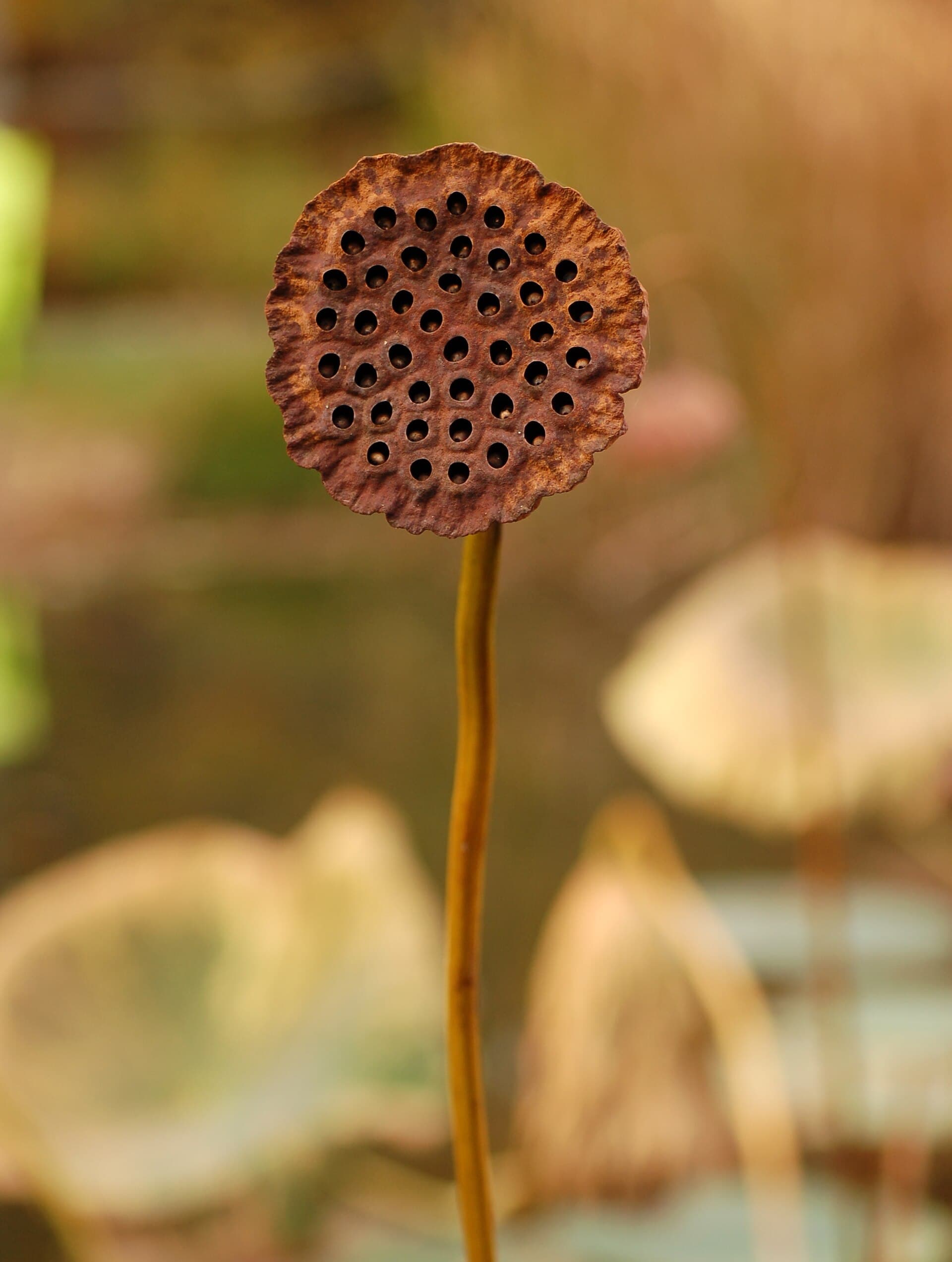
Photo: Pauline Eccles · CC BY-SA 2.0 · Wikimedia Commons
Poppy Pod
The poppy pod is the swollen, crowned seed head left after the bloom of Papaver somniferum has dropped its petals. Smooth and rounded with a distinctive ridged cap, it reads as a small sculptural sphere on a slender stem. Florists use pods fresh in a cool blue-green or dried to a muted grey-brown, prizing them for architectural texture in modern and minimalist designs. Long-lasting and endlessly reusable when dried, they add quiet, graphic structure to bouquets and installations.
| Family | Papaveraceae |
|---|---|
| Origin | Eastern Mediterranean and Western Asia |
| Peak season | July, August |
| Availability | January, February, March, April, May, June, July, August, September, October, November, December |
| Stem length | 30–70 cm |
| Vase life | 14–60 days |
| Colors | green, blue, brown |
| Price tier | mid |
Fresh green pods take up water well: recut on an angle and give a deep drink in cool, clean water. To dry them, harvest when firm and hang upside down in an airy space, where they fade to soft grey-brown and last for months. Dried pods need no water and hold their sculptural shape almost indefinitely.
- •Recut stems on an angle for fresh green pods
- •Use cool, clean water when displaying fresh
- •Hang upside down to dry to a lasting grey-brown
- •Keep dried pods out of damp to avoid softening
- •Handle by the stem to protect the crowned cap
 Bouquet Builder — by Lacy Bird
Design the bouquet. See it as a photo.
Botanical reference
- Common name
- Opium Poppy
- Also known as
- poppy seed head, dried poppy pod, poppy seed pod, Papaver album, Papaver album-nigrum, Papaver amoenum, Papaver amplexicaule, Papaver glabrum, Papaver hortense, Papaver indehiscens, Papaver nigrum, Papaver officinale
- Distribution
- Algeria, Baleares, Canary Is., Corse, France, Italy, Libya, Madeira
- Uses
- spice, medicinal plant, psychoactive drug, food
Open-data sources: GBIF, Wikidata (CC0/CC BY)
Frequently asked questions
When is Poppy Pod in season?
Poppy Pod peaks in July, August, and florists can usually source it January, February, March, April, May, June, July, August, September, October, November, December. Availability shifts by region and greenhouse supply.
How long does Poppy Pod last in a vase?
Expect 14–60 days with proper conditioning — a clean vase, fresh water every couple of days, flower food, and a cool spot away from ripening fruit and direct heat.
What can I use instead of Poppy Pod?
Good substitutes for Poppy Pod include Lotus Pod, Nigella, Craspedia, Strawflower. Match on look, colour and season — our substitute finder ranks the closest alternatives.
What does Poppy Pod symbolise?
Poppy Pod is associated with remembrance, sleep, peace, imagination.
How do you care for cut Poppy Pod?
Recut stems on an angle for fresh green pods
Related flowers


Free to quote and cite with attribution and a link back, for non-commercial and editorial use (blogs, journalism, classrooms, research).
Lacy Bird Flower Encyclopedia — “Poppy Pod”. https://lacybird.com/flowers/poppy-pod/<a href="https://lacybird.com/flowers/poppy-pod/">Lacy Bird Flower Encyclopedia — Poppy Pod</a>