Sympathy Flowers: What to Send to the Home, and When
How sympathy flowers differ from funeral flowers, what to send to a grieving family's home, when a late delivery beats a prompt one, and what to write on the card.
Funeral flowers have rules; sympathy flowers have judgement. Once you know the service arrangements are the family's territory — we cover those in the funeral flowers guide — everything that remains is the quieter question this page answers: what do you send to the people, to the house where someone is missing?
What counts as sympathy flowers
A sympathy arrangement is a normal, beautiful piece of floristry in a lowered voice. No easels, no ribbons with printed condolences, no formats you would never buy on an ordinary Tuesday. A vase arrangement, a basket, a generous hand-tied bouquet — delivered to the home, addressed to the living.
That ordinariness is the point. The family spends the funeral week surrounded by ceremonial flowers that belong to the event. What you are sending belongs to the kitchen table.
The palette: subdued, not sterile
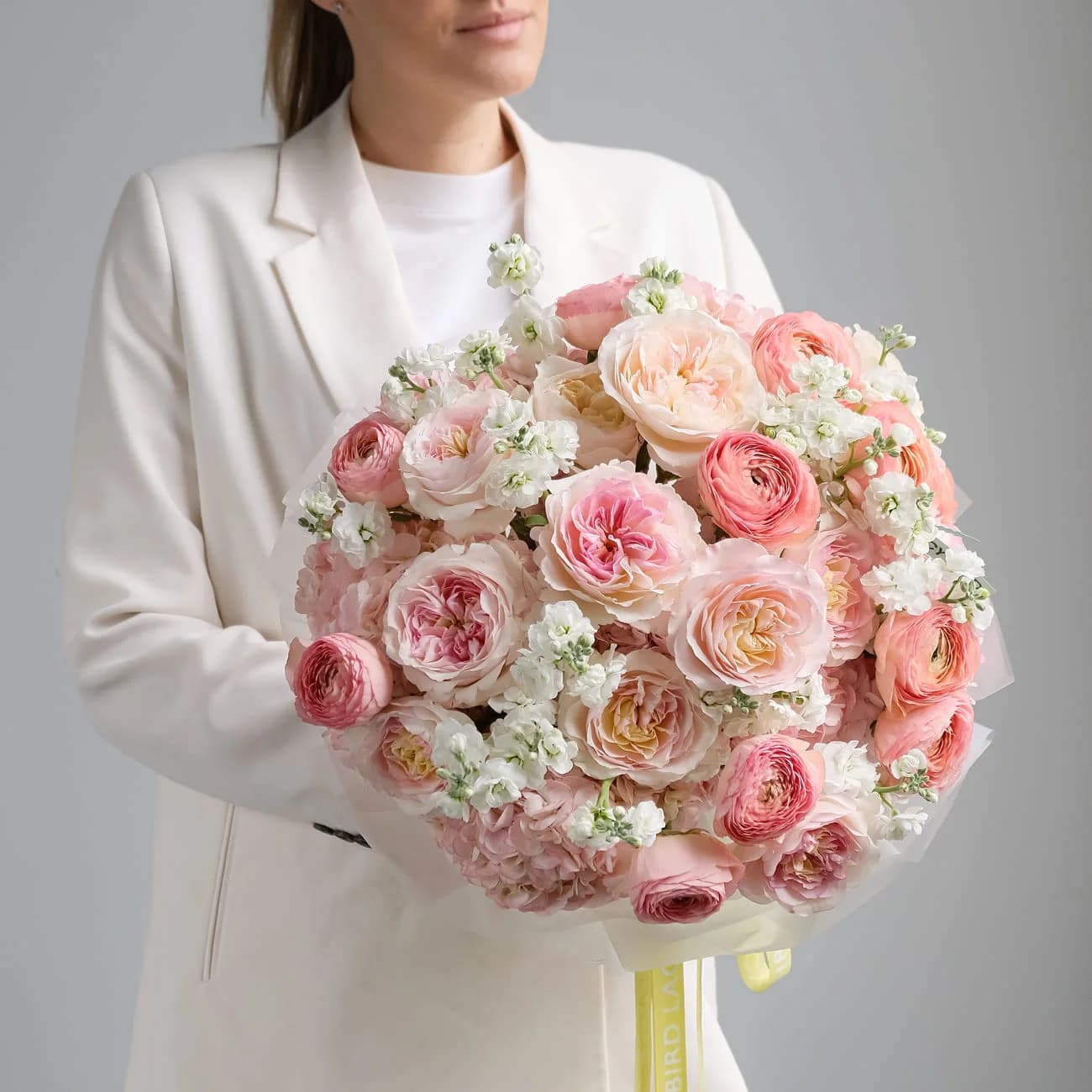
White is the default and it is never wrong: white roses, carnations, matthiola, chrysanthemums, lisianthus. But sympathy work does not have to be monochrome. Cream, soft green, dusty lavender and the palest pink all read as gentle rather than festive, and a touch of colour can carry meaning — the deceased's favourite shade, or the garden they kept.
Two honest guardrails:
- Avoid the celebration registers. Saturated reds, hot pinks and bright oranges are birthday grammar; they jar in a house in mourning.
- Avoid heavy fragrance if anyone is unwell. Oriental lilies are traditional but overpowering in a closed room. Ask your florist to keep scent moderate — matthiola gives perfume without the fog.
Timing: the second wave matters most
Here is the thing florists see every season and most senders never learn. In the first week after a loss, the house fills with flowers — and then, almost on a schedule, it empties. The calls taper. The food deliveries stop. Week three is when the quiet gets loud.
So the timing rule is generous: any moment from the news to a month after is appropriate, and the later deliveries often mean the most. If you hesitated and feel you missed the window — you didn't. You may have landed in the best one.
Practical notes:
- Don't deliver on the funeral day itself; the family isn't home and the doorstep is chaos. The day after, or a week after, is better.
- If the household observes a mourning tradition with its own customs — sitting shiva, a 40-day observance — ask the florist or a mutual friend what is welcome and when. Food or a donation may serve better than flowers in the early days.
Formats that work, and what they cost
Vase arrangement ($60-150). The gold standard. It arrives ready: water, vessel, shape. Nobody in that house should be searching cupboards for a vase.
Basket arrangement ($70-150). Sits anywhere, moves easily, and its own handle makes it feel composed rather than delivered. Our flower basket guide covers the format in depth.
Mono-bouquet ($40-90). A dozen white carnations, a sheaf of matthiola, ten white spray roses. Simple, dignified, and better value than a thin mix. Add a note telling the recipient it needs a vase only if you know the household well.
A living plant ($40-120). A peace lily or white orchid outlasts every cut stem and marks the months, not the week. Best for recipients you know to be plant people.
The card: two sentences, signed properly
Grief scrambles memory, and unsigned or initial-signed cards genuinely go un-thanked because the family cannot work out who sent them. Write your full name. Before it, two sincere sentences beat every formula:
- "We are so sorry for your loss. Maria brought light into every room — we will miss her too."
- "Thinking of you all this week and long after. With love, the Chen family."
- "No words — just know we are here, for errands or dinners or silence. Anna & Tom Becker."
Skip "at least she lived a long life" and every other sentence that begins with "at least." Comfort compares nothing.
Sympathy from a workplace
A team sending together should send one generous arrangement, not five small ones — a single $120 piece from "the whole team at Meridian" reads warmer than a scatter of supermarket bouquets. Have one person own the card and collect names; list them all if space allows. If the bereaved colleague is returning to work soon, a small arrangement waiting on their desk on day one — no fanfare, no crowd — is one of the kindest gestures an office can make.
When flowers are the wrong answer
Sympathy flowers are a Western default, not a universal one. Jewish tradition generally prefers a shiva visit, food, or a donation; Muslim families typically welcome charity in the deceased's name over arrangements. When the family has said "in lieu of flowers, please donate" — believe them, donate, and send a written card instead. The gesture behind the flowers translates perfectly; the flowers themselves sometimes don't.
If you are unsure, ask the funeral home or a mutual friend. Nobody has ever been offended by the question.