Minimalist Floristry: Five Stems, One Idea — the Style That's Harder Than It Looks
Minimalist flower style explained — the single-digit stem count, why the vessel is half the design, which flowers survive solo scrutiny, and how minimal differs from empty.
Every florist can fill a vase. The rarer skill is stopping — and minimalist floristry is the discipline of stopping made into a style. Three stems and a good shadow can hold a room that a hundred roses would merely decorate. But the style is unforgiving in direct proportion to its simplicity: with nowhere to hide, everything shows.
The grammar: line, air, vessel
Minimalism in flowers descends from ikebana far more than from Western arranging, and it inherits the three ikebana convictions: line matters more than mass (one curved delphinium does what no dome can), air is material (the space between stems is composed, not left over), and the vessel is half the piece — in a five-stem arrangement, the ceramic speaks as loudly as the botany.
Practical translation for the bench and the home table:
- Count in single digits — one to seven stems.
- Odd numbers and asymmetry — three angles, not a row.
- One idea — a colour, a curve, a season. The second idea is where minimal dies.
- Mechanics hidden or honest — a kenzan in a low bowl, or a narrow neck doing the work visibly.
Flowers that survive solo scrutiny
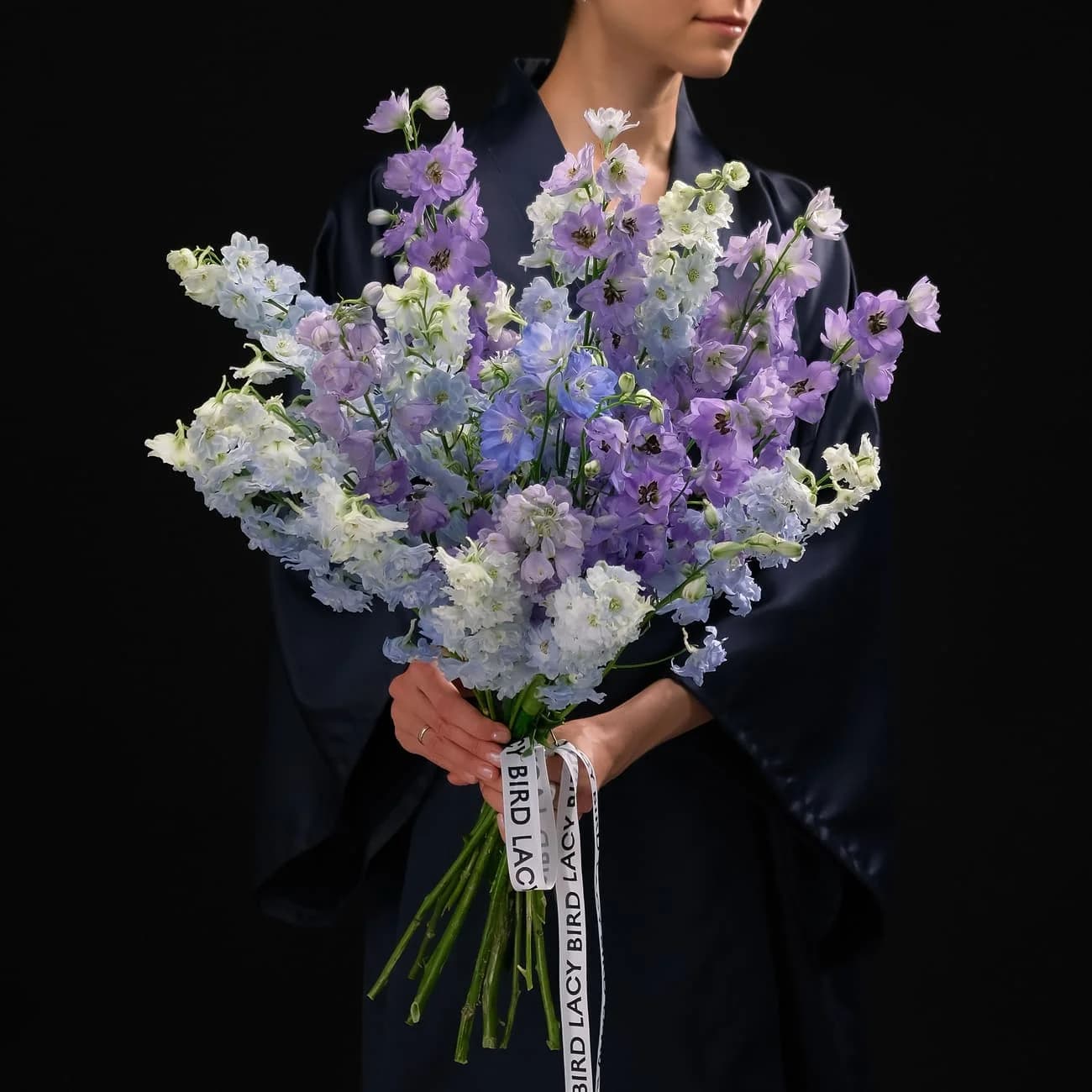
Mass arranging forgives individual flowers; minimalism cross-examines them. The stems that hold up alone: anthurium and calla (sculpture by birth), delphinium and foxglove (vertical drama), allium (geometry on a stick), one perfect peony or garden rose at full open, orchid stems, and — the minimalist's secret weapon — branches: quince or cherry in bloom, a curved willow, a pine limb in winter. A branch brings line, scale and season for the price of a single flower.
What fails: anything bred to be one of many. Spray fillers, gypsophila, small mixers — their beauty is statistical, and minimalism is a genre of individuals.
Minimal is not empty (and not cheap)
The style's paradox confuses clients annually: how is five stems worth studio money? Because the economics invert. In mass work, quantity covers grade; in minimal work every stem is on trial — the one rose must be the best rose in the cooler. The vessel is a real cost, chosen per piece. And the placement is the actual product: fifteen minutes of moving three stems millimetres is what separates a composition from a windowsill accident.
The distinction that matters — and that you can check on any piece including your own — is intention versus leftovers. Minimal: every element placed, angles chosen, air shaped. Empty: few flowers because few were bought. The first reads expensive from across the room; the second reads like Tuesday. (Same logic, at luxury scale, in our luxury flowers guide — restraint is the most expensive-looking material there is.)
The home practice
Minimalism is the most domestic of the styles — no other register rewards a small budget so well. The weekly exercise we give students: one branch or three stems, one good vessel, ten minutes. Place the tallest line off-centre and lean it; answer with a shorter angle; ground with one bloom sitting low. Then the hard part — stop, and take the piece somewhere it gets seen.
If it feels sparse on day one, wait before adding: sparse is usually the eye's unfamiliarity, not the arrangement's incompleteness. By day three the air in the composition starts reading as calm instead of absence — which is, in one sentence, what people are actually buying when they buy this style.