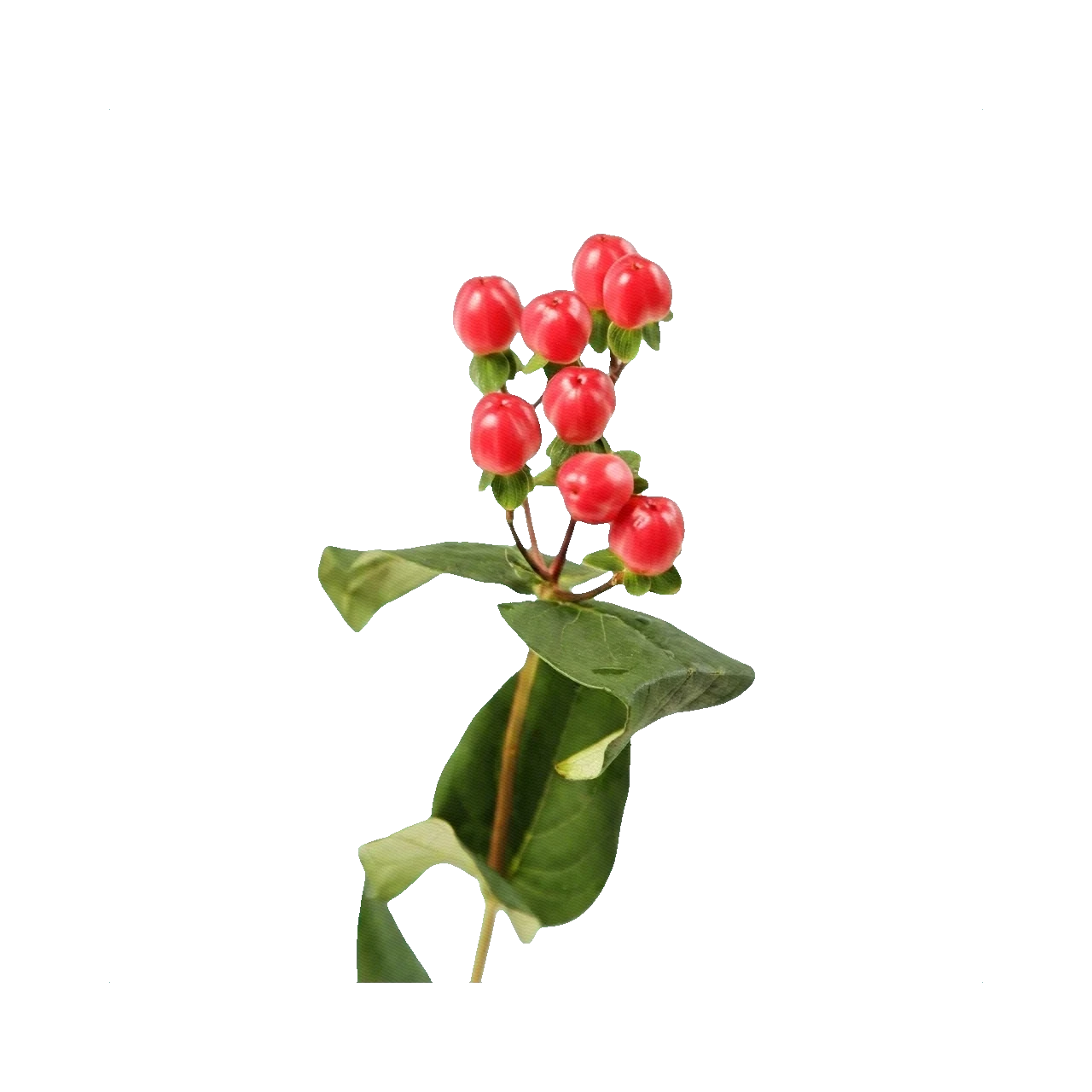
Hypericum Berry
Hypericum, known for its glossy St John's wort berries, is a woody stem crowned with clusters of firm, jewel-like fruits in red, green, peach, cream and burgundy. Florists reach for it year-round as a long-lasting, textural filler that adds a pop of colour and a modern, structural note. The berries hold beautifully out of water for a short time, making them ideal for buttonholes, crowns and cascading designs. Sturdy and reliable, it is one of the hardest-working accents in the cooler.
| Family | Hypericaceae |
|---|---|
| Origin | Europe and western Asia |
| Peak season | August, September, October, November |
| Availability | January, February, March, April, May, June, July, August, September, October, November, December |
| Stem length | 40–70 cm |
| Vase life | 7–14 days |
| Colors | red, green, peach, cream, burgundy |
| Price tier | mid |
Cut the woody stems at a sharp angle and strip any leaves that would fall below the waterline. The berries need little coaxing but appreciate a deep drink of cool water with flower food. Keep them cool to maintain the firm, plump look and prevent shrivelling. They are ethylene-tolerant and exceptionally long-lived.
- •Strip lower leaves before conditioning
- •Cut woody stems on a slant
- •Store cool to keep berries firm
- •Use flower food in clean water
- •Recut if berries begin to soften
3 named hypericum cultivars from the Lacy Bird master catalogue — each a distinct commercial variety.



Entries marked ✦ come from the Acanta master catalogue — the shared database of cut flowers, forms, colours and named varieties that florists and studios build on. The rest are our editorial genus reference. What is Acanta →
 Bouquet Builder — by Lacy Bird
Design the bouquet. See it as a photo.
Botanical reference
- Common name
- Bible-leaf
- Also known as
- st john's wort, tutsan, coffeeberry, Androsaemum androsaemum, Androsaemum floridum, Androsaemum officinale, Androsaemum officinale grandiflorum, Androsaemum vulgare, Hypericum androsaemum dilatatum, Hypericum androsaemum variegatum, Hypericum bacciferum, Hypericum bacciforme
- Distribution
- Algeria, Belgium, Bulgaria, Corse, France, Great Britain, Iran, Ireland, Italy, Lebanon-Syria
Open-data sources: GBIF, Wikidata (CC0/CC BY)
Frequently asked questions
When is Hypericum Berry in season?
Hypericum Berry peaks in August, September, October, November, and florists can usually source it January, February, March, April, May, June, July, August, September, October, November, December. Availability shifts by region and greenhouse supply.
How long does Hypericum Berry last in a vase?
Expect 7–14 days with proper conditioning — a clean vase, fresh water every couple of days, flower food, and a cool spot away from ripening fruit and direct heat.
What can I use instead of Hypericum Berry?
Good substitutes for Hypericum Berry include Ilex (winter berry), Skimmia, Waxflower, Viburnum, Sea Buckthorn. Match on look, colour and season — our substitute finder ranks the closest alternatives.
What does Hypericum Berry symbolise?
Hypericum Berry is associated with abundance, protection, resilience.
How do you care for cut Hypericum Berry?
Strip lower leaves before conditioning
Related flowers


Free to quote and cite with attribution and a link back, for non-commercial and editorial use (blogs, journalism, classrooms, research).
Lacy Bird Flower Encyclopedia — “Hypericum Berry”. https://lacybird.com/flowers/hypericum-berry/<a href="https://lacybird.com/flowers/hypericum-berry/">Lacy Bird Flower Encyclopedia — Hypericum Berry</a>