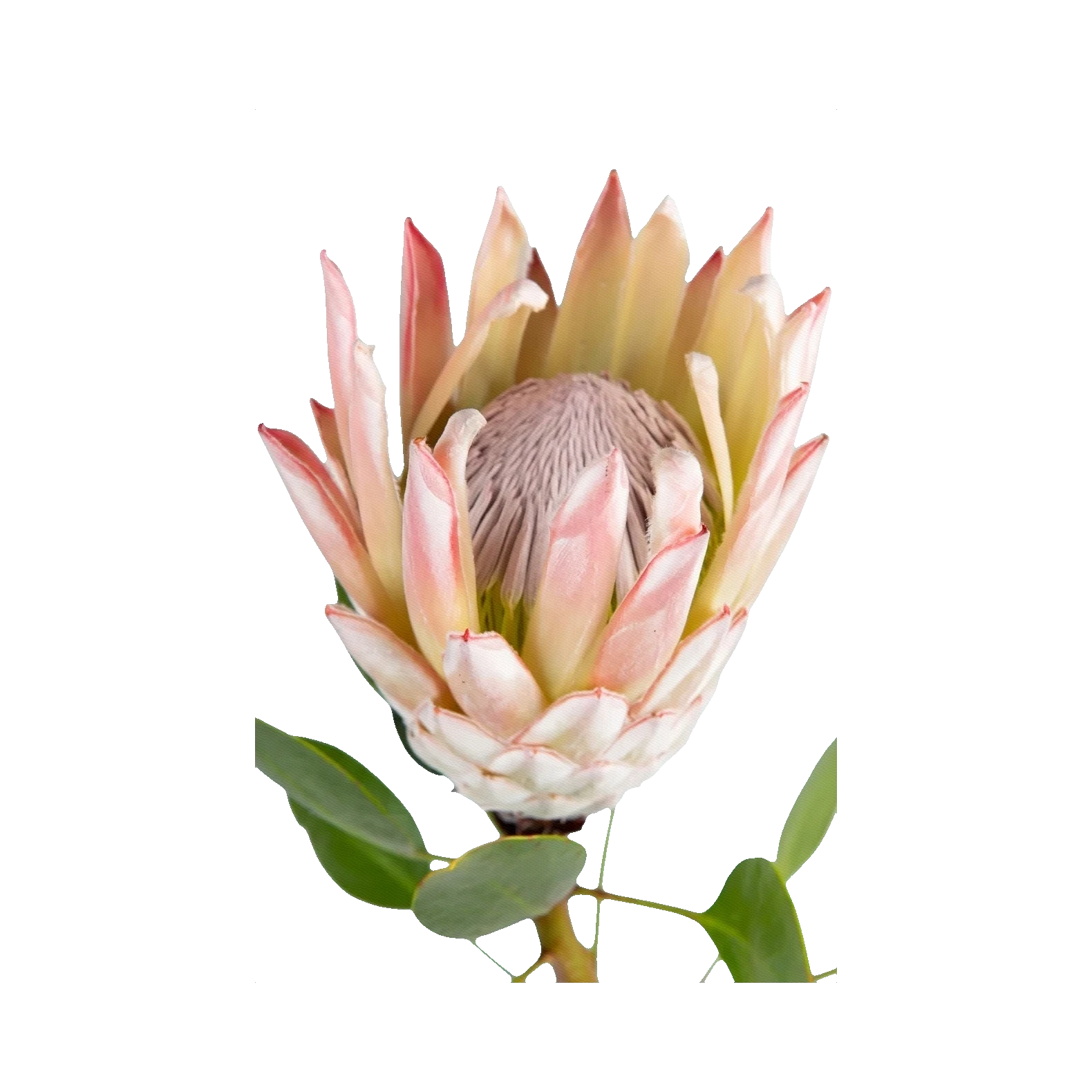
Protea
The protea is a flower with a personality — 300 million years of evolution, a South African native, and the design language of modern desert and tropical floristry. The king protea (P. cynaroides) reaches 25 cm across and functions as an entire arrangement in one stem. Dries perfectly; used widely in preserved wall art.
| Family | Proteaceae |
|---|---|
| Origin | South Africa; commercially grown South Africa, Australia, California, Hawaii |
| Peak season | May to October (Southern Hemisphere winter) |
| Availability | all year (imported) |
| Stem length | 40–80 cm |
| Vase life | 10–21 days |
| Colors | pink, cream, burgundy, green |
| Price tier | premium |
Cut on a diagonal, split woody stem 2 cm. Deep water is fine.
- •Prehistoric, architectural look — every stem is a sculptural piece
- •Dries beautifully — usable in preserved arrangements
- •Woody stem: split with pruners for water uptake
- •Long vase life — 2–3 weeks common
2 named protea cultivars from the Lacy Bird master catalogue — each a distinct commercial variety.


Entries marked ✦ come from the Acanta master catalogue — the shared database of cut flowers, forms, colours and named varieties that florists and studios build on. The rest are our editorial genus reference. What is Acanta →
 Bouquet Builder — by Lacy Bird
Design the bouquet. See it as a photo.
Botanical reference
- Common name
- Proteas
- Also known as
- king protea (P. cynaroides — the largest), Chrysodendron, Erodendrum, Leucadendron, Pleuranthe, Scolymocephalus, Serraria
- Distribution
- Angola, Benin, Botswana, Burkina, Burundi, Cameroon, Cape Provinces, Caprivi Strip, Central African Republic, Chad
- Cold storage
- 0–1 °C
Open-data sources: GBIF, Wikidata (CC0/CC BY), USDA Agriculture Handbook 66 (public domain)
Frequently asked questions
When is Protea in season?
Protea peaks in May to October (Southern Hemisphere winter), and florists can usually source it all year (imported). Availability shifts by region and greenhouse supply.
How long does Protea last in a vase?
Expect 10–21 days with proper conditioning — a clean vase, fresh water every couple of days, flower food, and a cool spot away from ripening fruit and direct heat.
What can I use instead of Protea?
Good substitutes for Protea include Banksia. Match on look, colour and season — our substitute finder ranks the closest alternatives.
What does Protea symbolise?
Protea is associated with diversity, transformation, resilience.
How do you care for cut Protea?
Prehistoric, architectural look — every stem is a sculptural piece
Related flowers



Free to quote and cite with attribution and a link back, for non-commercial and editorial use (blogs, journalism, classrooms, research).
Lacy Bird Flower Encyclopedia — “Protea”. https://lacybird.com/flowers/protea/<a href="https://lacybird.com/flowers/protea/">Lacy Bird Flower Encyclopedia — Protea</a>