Round Bouquet: Why the Dome Endures, and How to Order One That Isn't Boring
The round bouquet explained — the spiral that builds the dome, compact vs garden-round, why it suits every dress, honest prices, and how to keep the classic from going generic.
Every few years wedding media declares the round bouquet over — replaced by the cascade, the asymmetric sheaf, the single giant anthurium. And every year, when the season's numbers are counted, the dome wins again. There is engineering behind that stubbornness, and knowing it helps you order a round bouquet that is classic without being a cliché.
The spiral underneath
A round bouquet is what geometry does when every stem enters the hand at the same slight angle. Build the spiral correctly — each stem laid across the last, all turning one direction — and the dome forms itself: even, self-supporting, comfortable to hold in one hand. That spiral is the first technique every florist drills (the full method is in our hand-tied guide), and the round bouquet is its natural product — which is exactly why the shape is floristry's baseline rather than its invention.
The engineering payoffs are the reasons brides keep choosing it, whether they name them or not: it has no bad angle for a photographer circling a first dance; it survives wind, car doors and two hundred hugs; and it balances — a round bouquet carried for six hours doesn't argue with the wrist the way a directional piece does.
Two registers: compact and garden
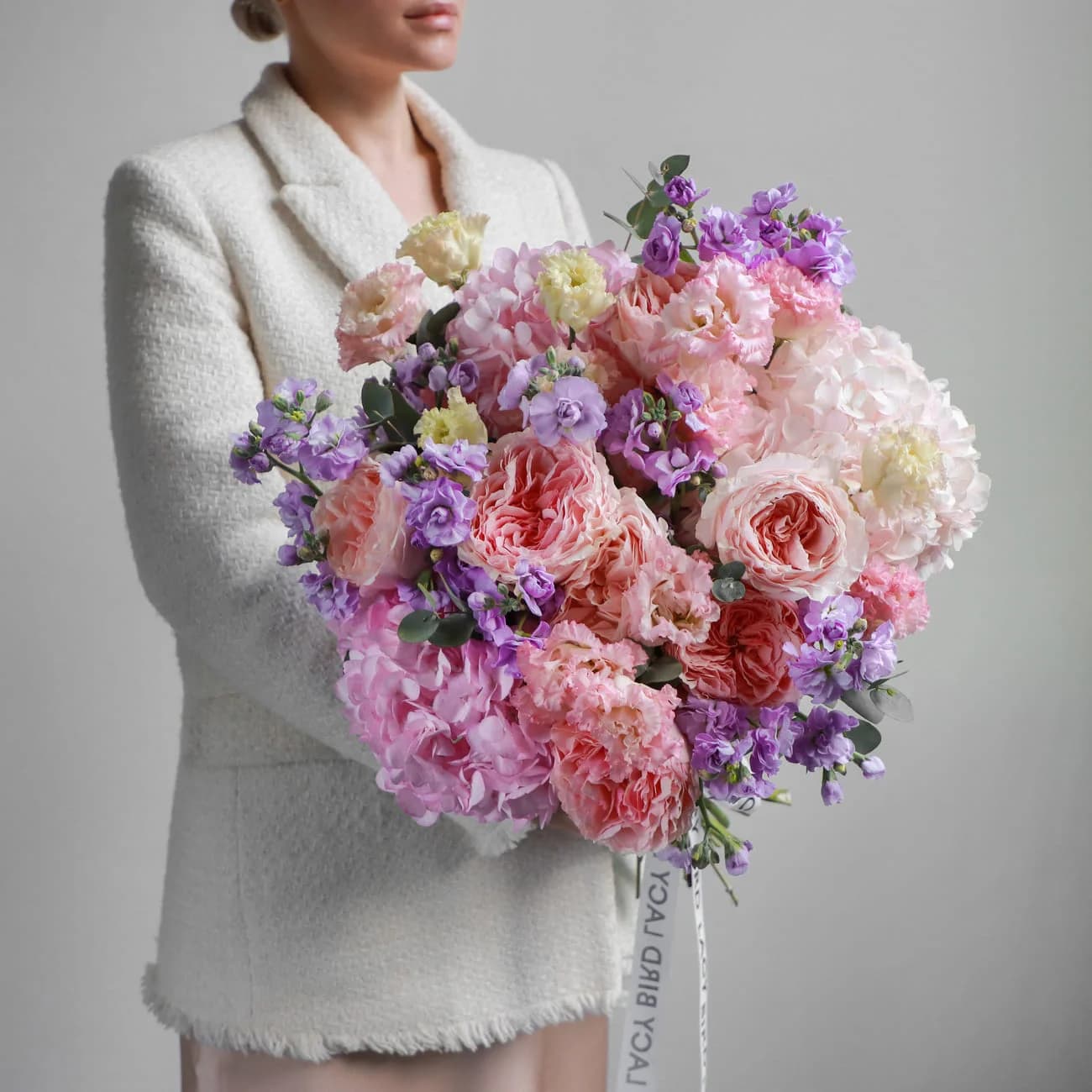
The compact round is the formal dialect: blooms set close, dome edge crisp, palette usually tight. Roses, ranunculus, peonies — this is the silhouette royal weddings default to, and it pairs with structured gowns and classical venues.
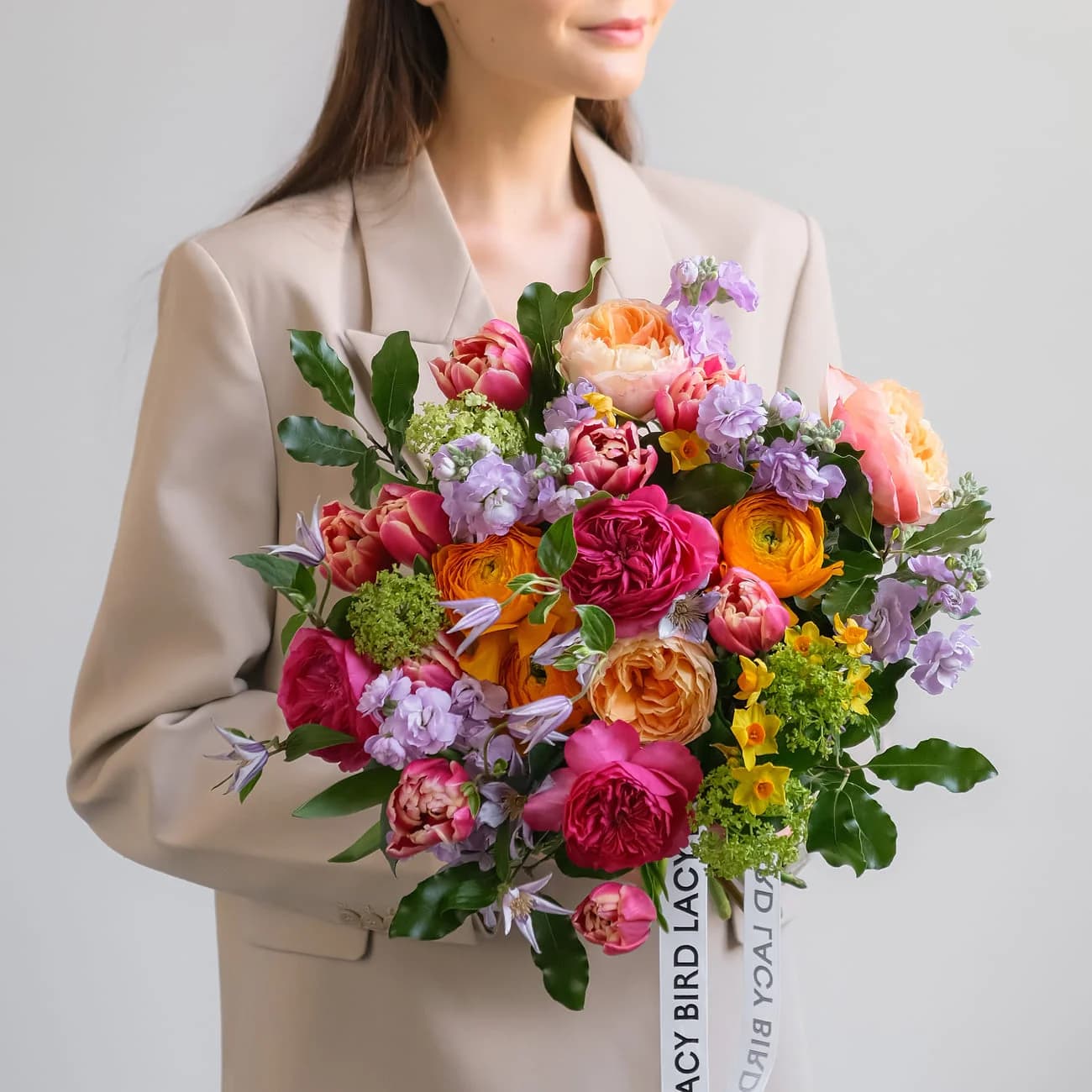
The garden round keeps the dome but loosens the border: stems at slightly different depths, textures mixed, a few elements breaking the dome line like plants overgrowing a hedge. Same engineering, more air — the register that suits relaxed venues and unstructured dresses, and the one that photographs as "effortless" after a very deliberate hour of work.
Between them sits most of the world's actual bridal work — and the choice is a dress-and-venue conversation, not a trend one.
The value argument nobody makes out loud
A round bouquet takes a senior florist 40-60 minutes; a cascade takes three hours or more. Same flowers, wildly different labour — which is why the round delivers the most bloom per unit of budget of any bridal shape: $80-150 compact in standard material, $150-250 in garden roses and peonies. If the budget conversation is tight, the professional advice is consistent: buy better flowers in a round before buying a harder shape in worse ones. Nobody at the wedding counts construction hours; everyone sees whether the roses were good.
Anti-generic: the recipe lever
When a round bouquet bores, the shape is innocent — the recipe did it. Four levers that keep the classic alive, from our bench:
- Texture spread. Three bloom scales minimum — a large face, a mid ruffle, a small accent — plus one non-floral texture: berries, grasses, a fruiting branch.
- Depth. Let a few stems sit a centimetre proud of the dome; perfect billiard-ball smoothness is what reads "supermarket."
- One palette tension. Cream-and-blush plus a wine note; white-and-green plus a chocolate cosmos. One tension, not three.
- A signature stem. One flower the recipient will name later — a striped tulip, a ‘Toffee’ rose, a sandersonia arc. Memory attaches to specifics.
The round bouquet has survived every fashion since the Victorians because it is not a style — it is a format, the way the sonnet is a format. What you write inside it is the actual decision, and that's the conversation worth having with your florist.