Wedding floristry
Wedding Bouquets — a working florist's guide
Every wedding bouquet type worth knowing — bridal, bridesmaid, cascade, hand-tied, biedermeier — with sizing, palette matching, and design principles used in our studio.
The bridal bouquet is the most-photographed floral element of any wedding. It appears in the ceremony, the group portraits, the couple's first-look frames, and half of the reception candid shots. It defines the palette and sets the aesthetic register for every other piece of floristry in the day.
This is the working florist's guide to wedding bouquets — the shapes worth knowing, how to choose between them, and the design principles our studio uses to build them.
The five bouquet shapes that matter
Modern wedding floristry has settled on five bouquet silhouettes. Everything else is a variation on one of these.
Hand-tied round
The default modern wedding bouquet. Round or slightly asymmetric, 20-40 cm across, hand-tied with the spiral technique so it stands on its own base. Works with any palette, any wedding style, any bridal outfit.
Read how to make a hand-tied bouquet for the technique.
Cascading
Elongated silhouette with stems arching or trailing downward on the front side of the bouquet. Reads dramatic and formal. Best for full-length gowns, tall brides, or brides who specifically want statement floristry.
Sized 30-50 cm across at the top, extending 20-40 cm down the front. More labour-intensive than round; more expensive to price.
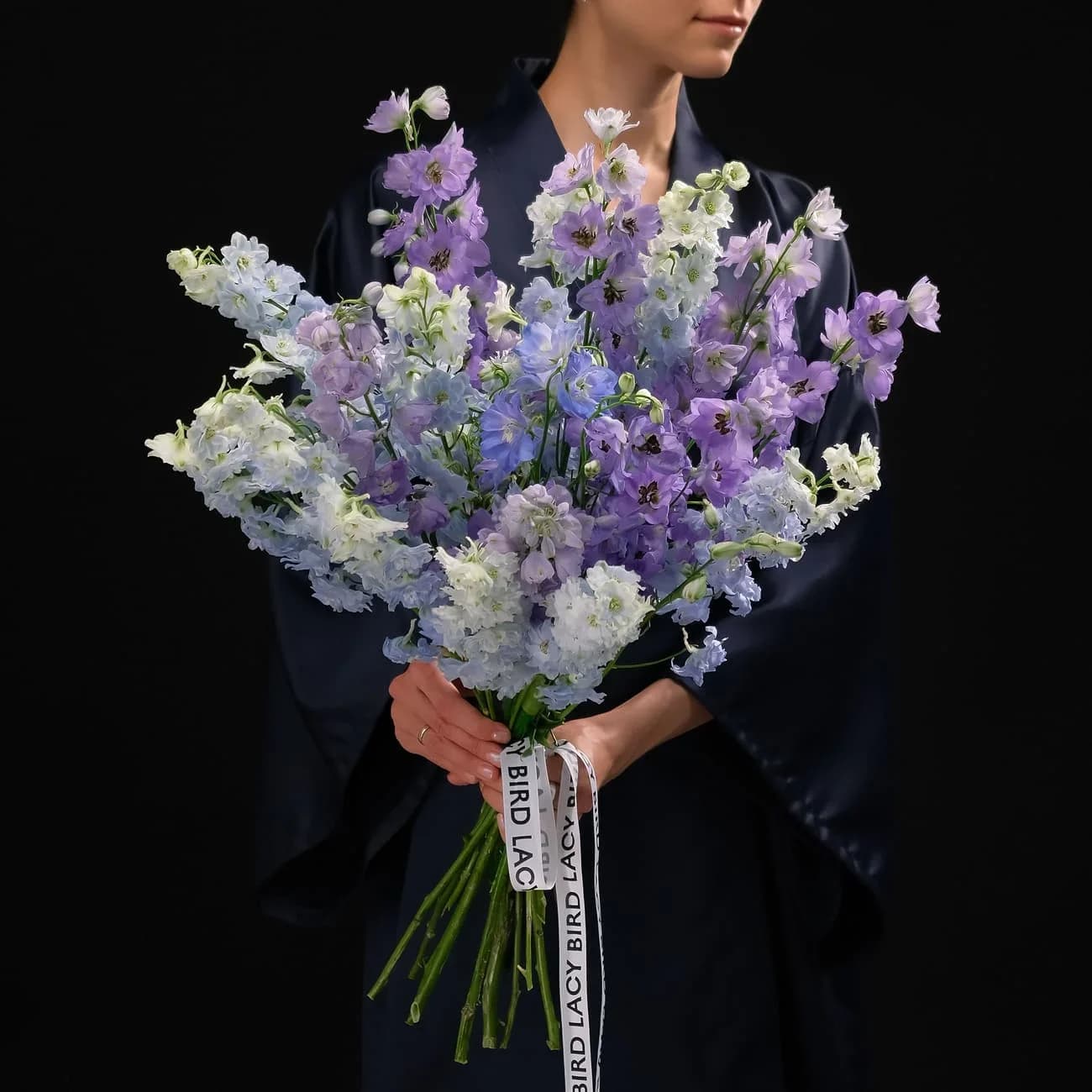
Compote-style
Loose, garden-inspired bouquet with stems visibly extending outward at different lengths. Reads modern, editorial, and slightly wild. Photographs beautifully at close range.
Structured / architectural
Precise, controlled silhouette — often symmetric, often with fewer flower types but higher density. Reads formal, minimalist, and contemporary. Popular with fashion-forward brides.
Bridal single-stem
One dramatic flower — a single garden rose, a large peony, an anthurium — wrapped in silk ribbon. Reads editorial and unusual. Works for elopements and vow renewals; often chosen by brides who dislike traditional bouquets.
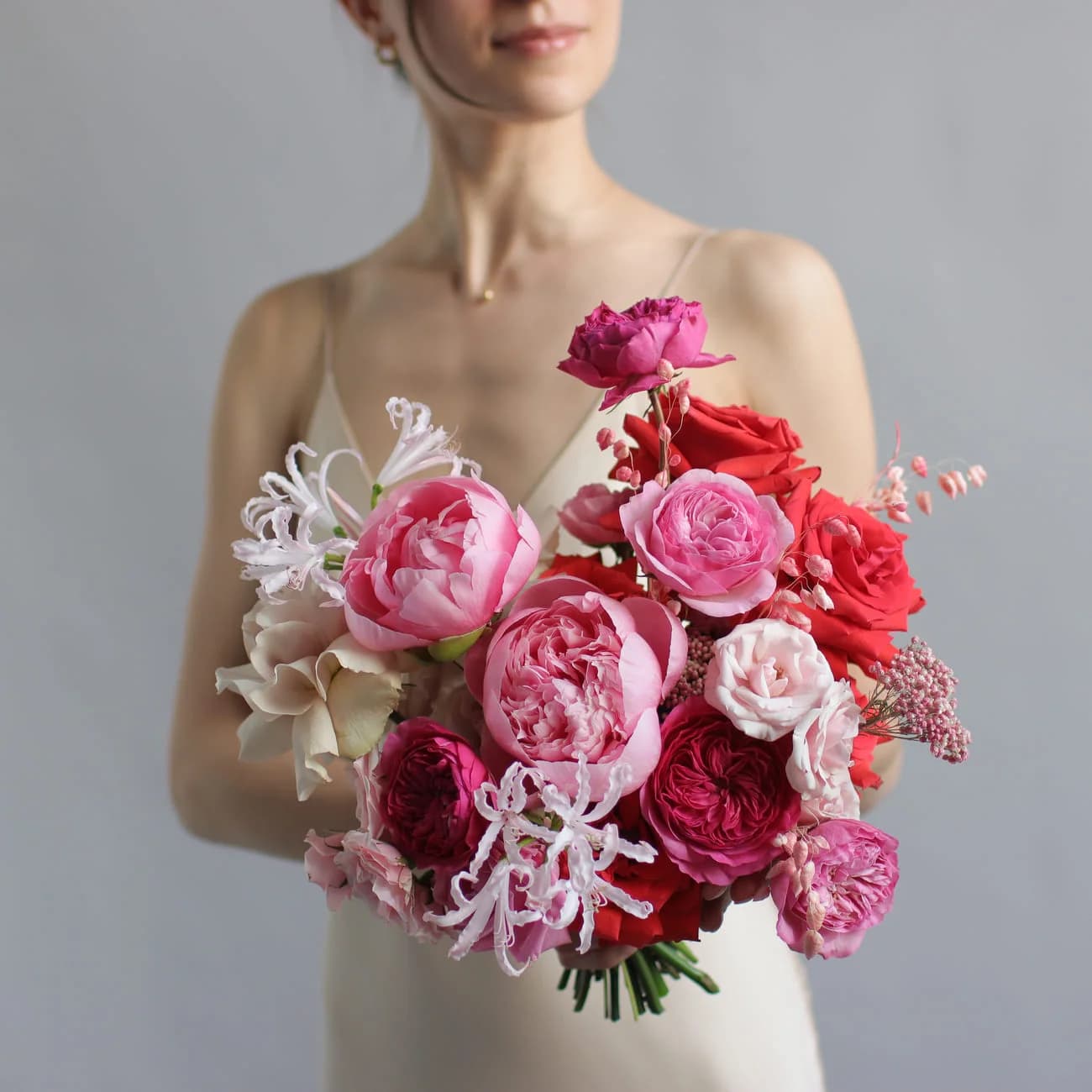
Choosing the right shape
Ask in this order:
1. What silhouette suits the dress? A full ball gown carries a cascading or larger round bouquet. A sheath or slip dress needs a smaller, compote-style piece. Fabric weight matters: heavy satin balances a statement bouquet; light chiffon looks better with restraint.
2. What does the wedding aesthetic call for? Garden and farm weddings — compote or hand-tied round with loose foliage. Ballroom and formal — structured or elegant cascading. Elopement and editorial — bridal single-stem or unusually-shaped compote.
3. What's the season? Peak flower seasons unlock premium bouquet options. If your wedding is May-June, peonies dominate. September-October, dahlias. Spring, ranunculus and tulips. Outside peak, garden roses are the year-round default.
4. What's the budget? Simple round bouquets in commercial roses start around $150. Cascading bouquets with garden roses and specialty flowers range $400-1,200. Bridal single-stems in luxury varieties (Coral Charm peonies, David Austin garden roses) $250-500 depending on scarcity.
Bridesmaid and family bouquets
Bridesmaid bouquets are usually scaled-down versions of the bridal bouquet — same palette, 60-70% of the size, and slightly simplified in flower selection. Modern trend is to give each bridesmaid a slightly different bouquet within a shared palette rather than five identical pieces.
Family bouquets for mothers, sisters, aunts, or grandmothers are typically small hand-tied bouquets in the wedding palette. Roughly 50-60% the size of a bridesmaid bouquet.
Palette matching
Wedding bouquets have to work in three colour contexts simultaneously: against the bridal gown fabric, against the bridal party attire, and against the venue lighting.
Rules we use:
- Palette samples must be physical. Screen colours don't match flower colours. Bring a fabric swatch, a printed invitation, a lipstick — real physical objects with the target palette.
- Match at 60% not 100%. A bouquet that exactly matches the bridesmaid dresses reads as costumey. A bouquet that harmonises with 60% colour-continuity looks intentional.
- Neutrals win in photos. Cream, blush, ivory, sage — these photograph well in every lighting condition. Bright colours (coral, yellow, magenta) can look garish under warm venue lighting.
- Foliage is a colour choice too. Silver-grey eucalyptus vs sage-green ruscus vs deep-green ferns each cast a different tone across the bouquet.
What we don't do anymore
- Baby's breath as a filler. Peaked in 2015 and now reads dated.
- Sprayed or dyed flowers. Novelty at best, tacky in most photos.
- Foam-based bouquet frames. Every professional bouquet is now foam-free, built with spiral hand-tie construction.
- Baby-pink ribbon on white bouquets. The classic 1990s-2000s look that photographs poorly in modern settings.
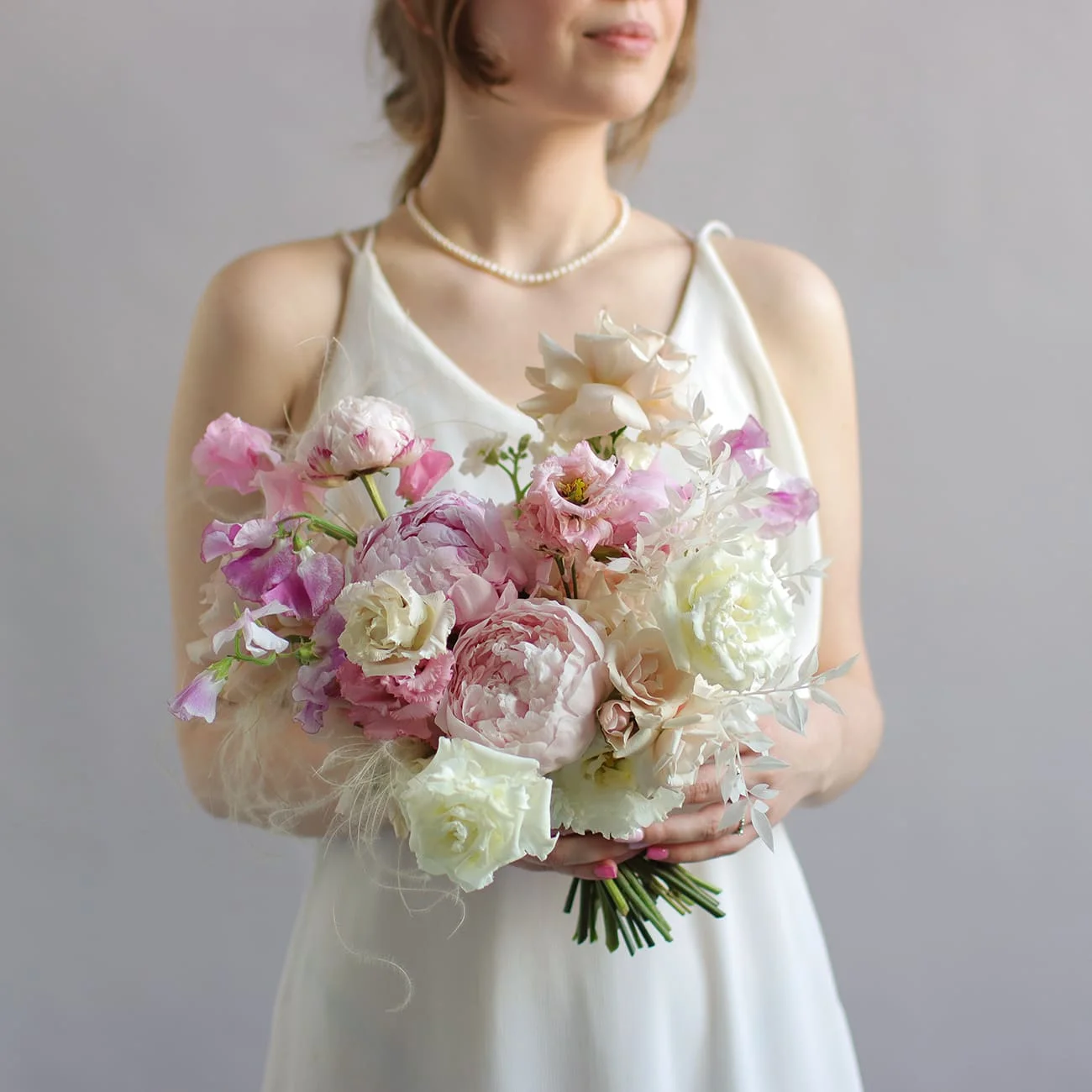
The production timeline
For working florists reading this — this is our production sequence for a typical mid-size wedding bouquet:
- 7-10 days before — order flowers from wholesalers or growers
- 3-5 days before — flowers arrive at studio; conditioning begins
- Day before wedding — final palette check with client; assembly starts
- Morning of wedding — final touches, ribbon wrap, delivery to venue
- Ceremony time — bouquet in bride's hands, still fresh at ceremony
- Reception — photograph opportunities continue
Every wedding-scale bouquet gets rebuilt if any single element wilts during transport. This is normal and included in our project pricing.
Related
- How to make a hand-tied bouquet — the spiral technique
- How to wrap a bouquet — five wrap styles
- Wedding centerpieces — the pieces that pair with the bouquet
- Wedding boutonnieres — the groom's side
- Peonies season — for peak-season weddings
- Wedding color palettes — palette deep-dive
- Order wedding bouquets in Dubai — our studio services
Book wedding florals
Enquire about your weddingIn this section
- Read →
Modern Wedding Bouquet — design principles
The modern wedding bouquet — soft palettes, generous shapes, restraint, movement. What actually makes a bouquet 'modern' vs traditional, with examples and studio principles.
- Read →
Rose Wedding Bouquet — the complete design guide
Types of roses for wedding bouquets, colour meanings, cost tiers, and specific bouquet designs from a studio that has made hundreds of them. From all-white classical to modern garden mixes.
- Read →
Hand-Tied Wedding Bouquet — a designer's guide
The hand-tied wedding bouquet — the default modern shape. Sizing, construction, how to choose one, how much they cost, and what to ask your florist about.
- Read →
Lily Wedding Bouquets: Best Types of Lilies, Meaning & Cost
The lily types that work in bridal bouquets — Oriental, Calla, LA hybrids — with symbolism, cost tiers and safety notes (pollen, cat toxicity). Real designs from our studio.
- Read →
Peony Wedding Bouquet — season, cost, and design
Peonies are the most-requested wedding flower in the northern hemisphere. Here's when they're in season, what off-season alternatives cost, and specific bouquet designs from our studio.
- Read →
Tulip Wedding Bouquet — season, types, and design
Spring tulip bouquets, double tulips as peony alternatives, cost tiers, and how to work around the fact that tulips keep growing after cutting. Designs from our studio.
- Read →
Toss Bouquet — the working design guide
The small secondary bouquet the bride throws — why it exists, what it should look like, cost tier, and modern alternatives (breakaway bouquet, garter, or skip entirely).
- Read →
Cascade Bouquet: What It Is, What It Costs, and Who It Flatters
The cascading wedding bouquet explained — how the waterfall shape is built (wired vs armature), which flowers trail well, honest pricing, and which dresses it works with.
- Read →
Round Bouquet: Why the Dome Endures, and How to Order One That Isn't Boring
The round bouquet explained — the spiral that builds the dome, compact vs garden-round, why it suits every dress, honest prices, and how to keep the classic from going generic.