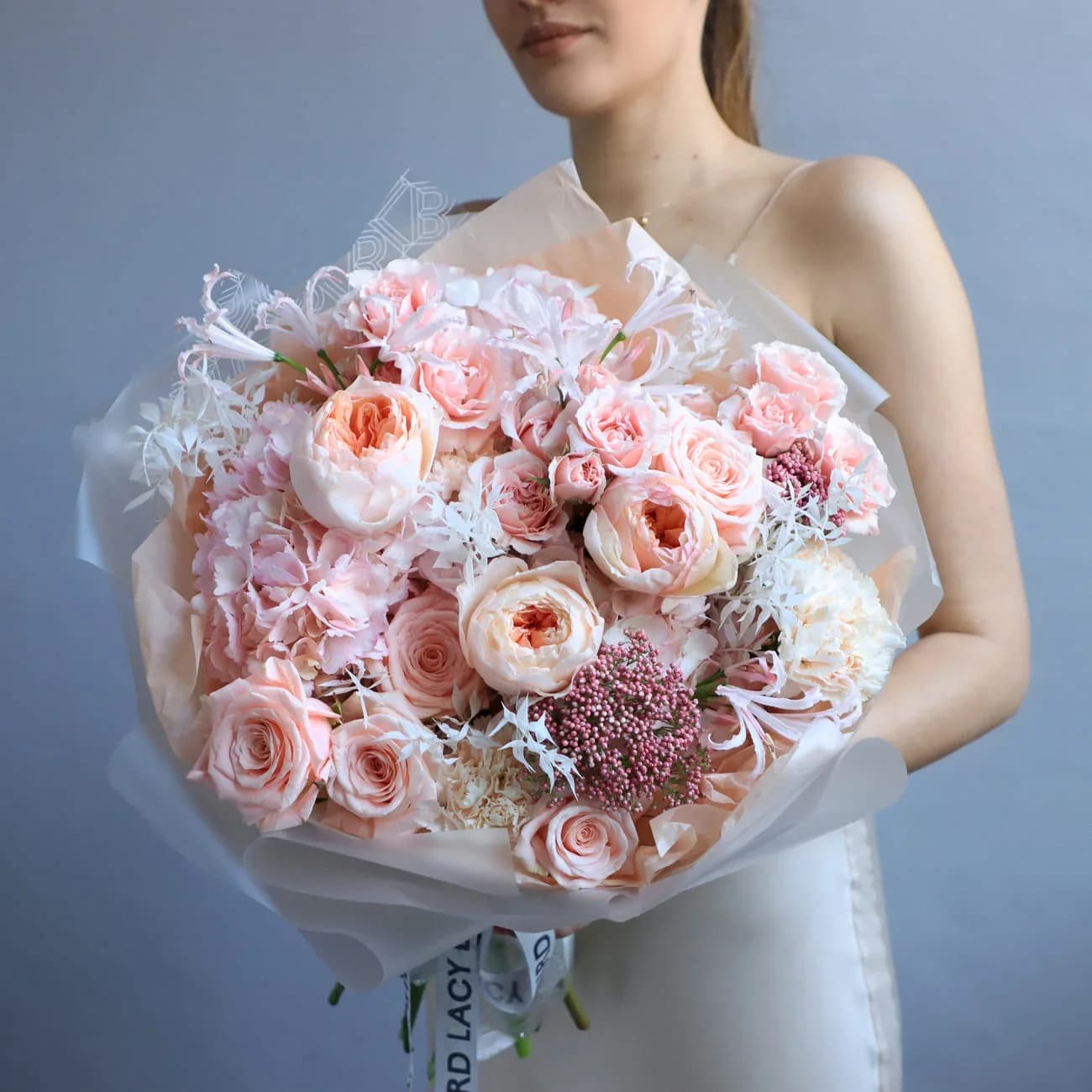
Hand-Tied Wedding Bouquet — a designer's guide
The hand-tied wedding bouquet — the default modern shape. Sizing, construction, how to choose one, how much they cost, and what to ask your florist about.
The hand-tied bouquet is the default modern wedding bouquet shape. It's what you get when you ask a modern florist for a bridal bouquet without specifying further. It's what almost every wedding-industry photograph shows. And it's built on a specific technique — the spiral — that has displaced the foam-based construction that dominated wedding floristry for decades.
This guide covers what a hand-tied wedding bouquet actually is, how to choose one, and what to ask your florist about.
What "hand-tied" means
A hand-tied bouquet is assembled entirely in the hand — no external mechanic (no vase, no foam, no wire cage). Stems are added one at a time, each angled the same way, so they cross at a single tie-point at the neck of the bouquet. Below the tie-point, stems fan into a base the bouquet can stand on. Above, flowers open into the visible shape.
The whole structure is held together by the spiral geometry itself, then bound at the tie-point with a rubber band, twine, or ribbon.
Why it matters: hand-tied bouquets photograph better than foam-based bouquets because you can see through them slightly — the negative space between stems adds visual depth. They also travel and hold together better because the mechanical structure IS the stems themselves.
For the full building technique, see our step-by-step guide how to make a hand-tied bouquet.
Common hand-tied wedding bouquet variations
Within the hand-tied family, five distinct silhouettes are worth knowing:
Round hand-tied. Symmetric round or slightly asymmetric. The default. 20-40 cm across. Works with any wedding style.
Cascading hand-tied. Elongated silhouette with stems trailing downward on the front. Reads formal and dramatic. 30-50 cm at top, extending 20-40 cm below.
Compote-style hand-tied. Loose, garden-inspired with stems visibly extending outward. Reads modern and editorial. Signature of the modern floral design aesthetic.
Structured hand-tied. Precise, controlled, often symmetric. Reads minimalist and architectural. Fewer flower types, higher density per type.
Bridesmaid hand-tied. Same technique, smaller size (60-70% of bridal scale). Typically simplified palette — one or two focal flowers with supporting texture.
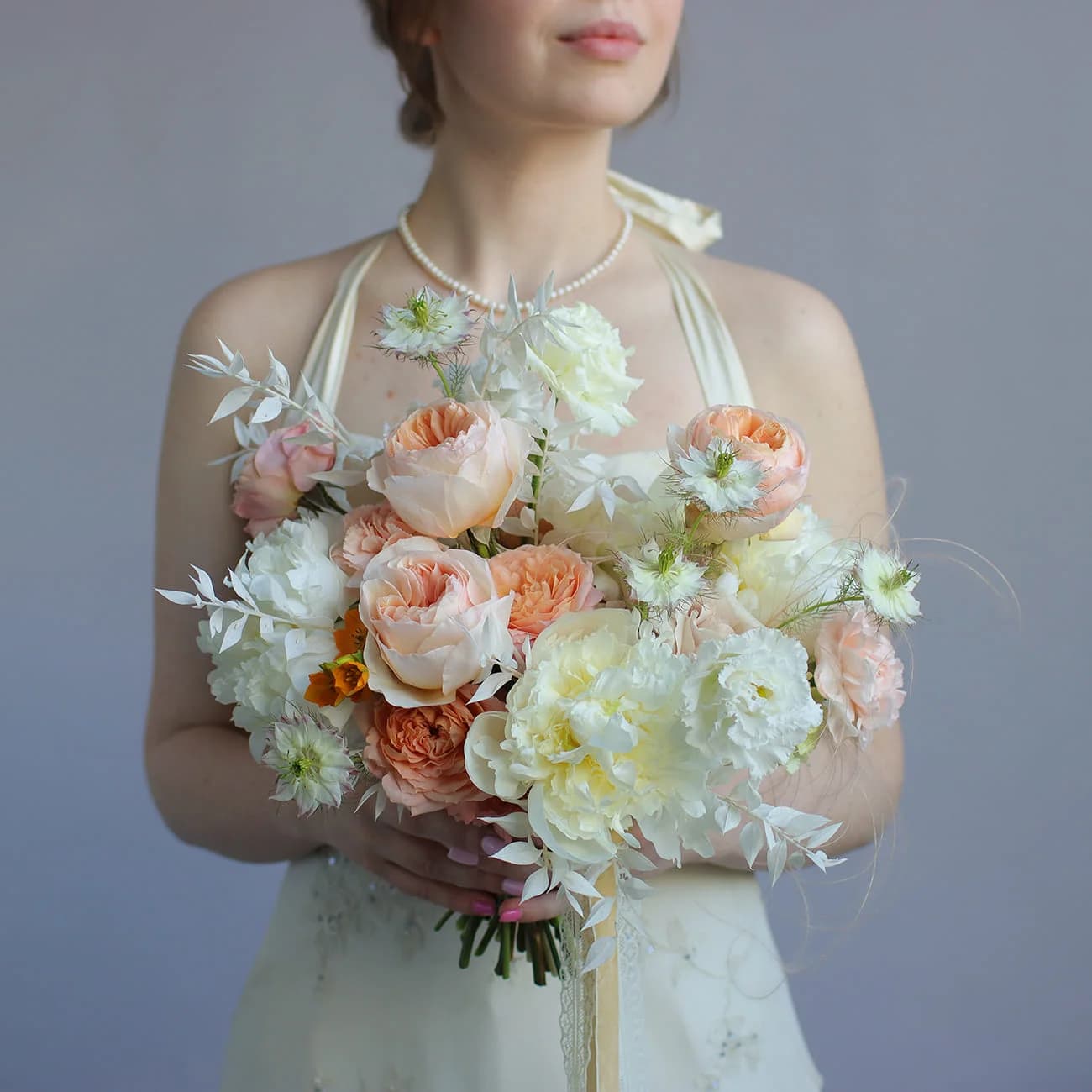
Sizing
Approximate diameters for hand-tied bridal bouquets:
- Petit — 18-22 cm across. Elopements, second-time brides, delicate dresses.
- Standard — 22-30 cm across. Most weddings. Balanced with most silhouettes.
- Statement — 30-40 cm across. Ball gowns, formal weddings.
- Cascading — 25-35 cm at top, +20-40 cm cascade length.
The wrong-size mistake goes one way: too small. A petite bouquet on a large ball gown looks lost. A statement bouquet on a slip dress looks appropriately dramatic. When in doubt, size slightly larger.
Palette matching
The bridal bouquet is the palette anchor for the wedding. Every other floral element — centerpieces, boutonnieres, bridesmaid bouquets — is matched back to it.
Bring physical palette samples to the florist consultation:
- A fabric swatch from the bridal or bridesmaid attire
- The invitation suite (printed, not digital)
- A lipstick tone if it's significant
- A ribbon or accessory colour if relevant
Discuss:
- Whether the bouquet leads the palette or matches it
- Which flowers are non-negotiable (usually one focal — peonies for a May bride, garden roses year-round)
- Which flowers to avoid (allergies, symbolism, past-relationship associations)
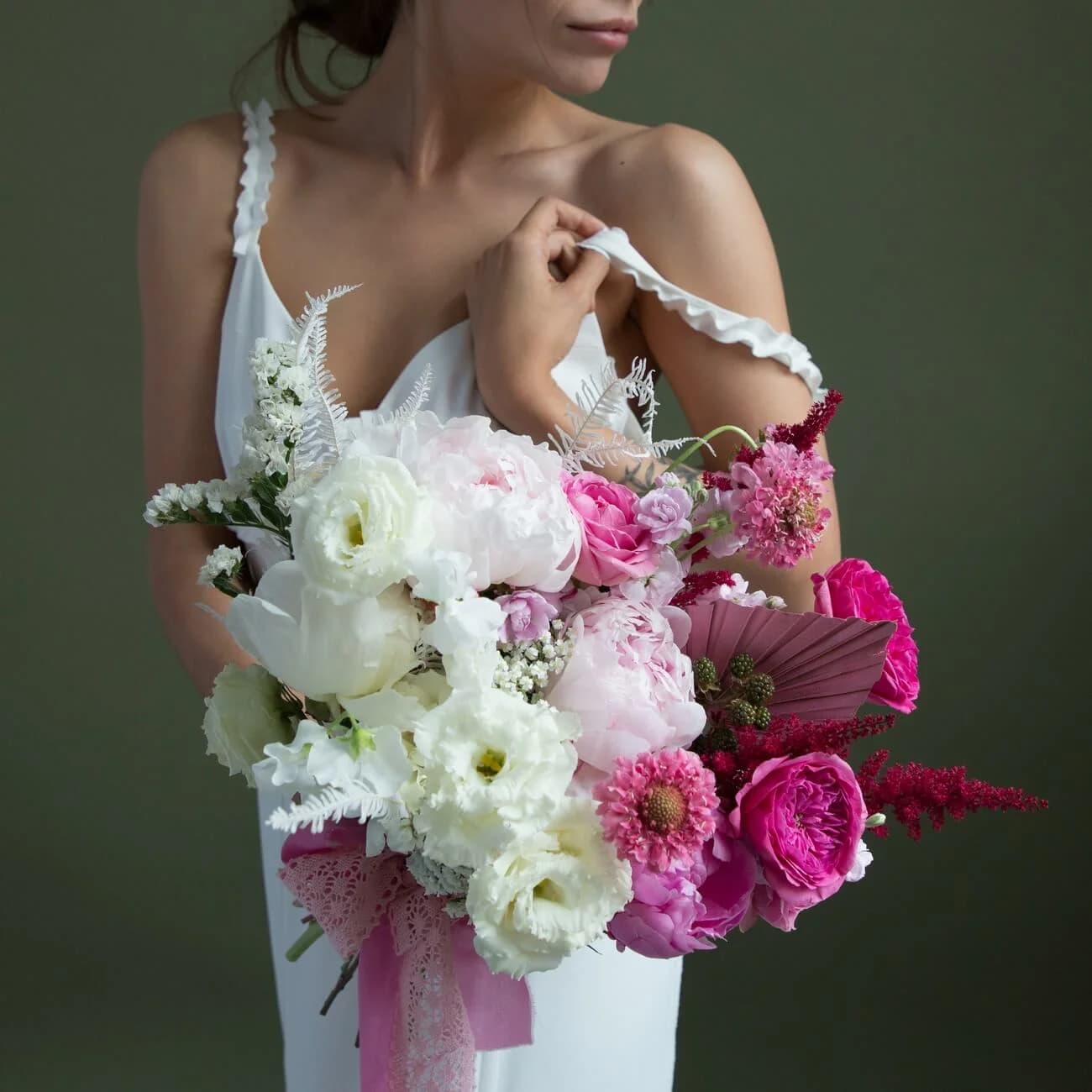
What to expect from your florist
Consultation. 30-60 minutes, in person or via video. Moodboard, palette samples, flower preferences, budget alignment.
Proposal. Written quote with bouquet dimensions, flower list, foliage list, ribbon or wrap, and price. Legitimate florists send this within 5-7 days of consultation.
Trial (larger weddings only). Some couples request a bouquet trial run 4-6 weeks before the wedding — the florist builds a sample bouquet to confirm palette and proportion. This is a paid add-on typically $150-400.
Delivery. Morning-of, in a hydration pocket, wrapped for transport. Ribbon is typically finished on-site to prevent damage during travel.
Post-wedding. Bouquets have a 3-5 day vase life after the wedding. Some brides preserve or press their bouquet — discuss the process before the wedding if this matters.
Pricing
Approximate US market pricing 2026:
- Petite hand-tied — $150-300
- Standard hand-tied — $300-600
- Statement or cascading — $600-1,200
- Luxury (peonies + garden roses + specialty flowers) — $800-1,800
- Very luxury (imports, out-of-season peonies, editorial specialty) — $1,500-3,500+
Bridesmaid bouquets: 40-60% of the bridal bouquet price. Family bouquets: 30-40% of the bridal bouquet price. Boutonnieres: separate pricing, typically $15-45 each — see the full boutonnieres guide.
Timing considerations
Order wedding bouquets when you book the florist — usually 6-12 months before the wedding date. Specialty flowers (peonies out of season, garden roses in specific varieties) require ordering 3-6 weeks ahead through wholesale channels.
For seasonal availability of specific flowers:
- Peonies season — May-June Northern Hemisphere, October-January Southern
- Tulips season — March-May main season
- Dahlias season — August-October
- Ranunculus season — January-May
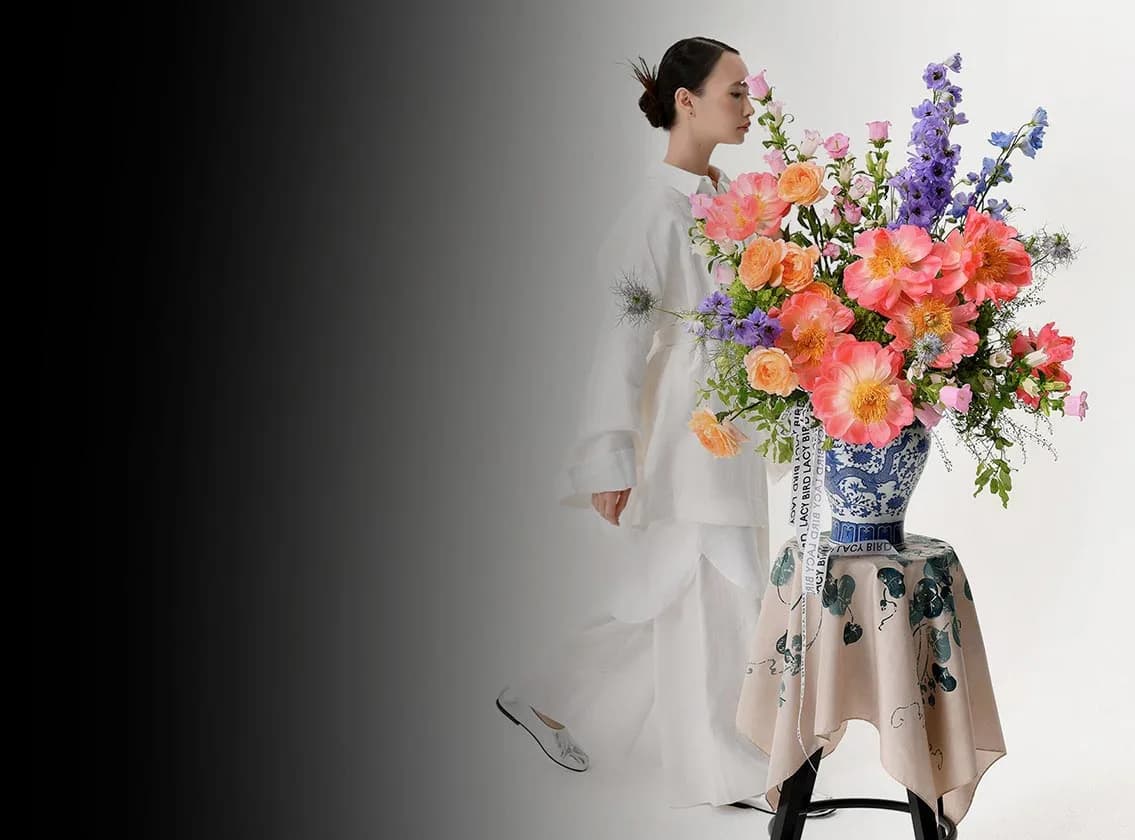
Common mistakes brides make
Pinterest-only reference. Photos on Pinterest are often heavily edited, professionally lit, and from top-tier florists. Show your florist Pinterest as reference, but ask them to show you what's achievable in your budget.
Choosing bouquet size before choosing dress. Get the dress first (or at least a sample fitting). Then size the bouquet against it.
Skipping the consultation. Trying to spec a wedding bouquet by email or Instagram DM. Consultations are where florists calibrate colour tones, silhouette proportions, and what will actually work with your specific wedding.
Assuming "modern" means "cheap". Modern floral design is not a budget aesthetic — it uses specialty flowers and textural elements that cost more than commercial-grade material. See our guide on what makes a modern bouquet modern.
Frequently asked questions
Can I DIY my own hand-tied bouquet?
For small weddings and elopements, feasible — see our hand-tied bouquet tutorial. Beyond 5 bouquets total (bride + 4 bridesmaids), the logistics overwhelm most non-florists. Budget 4-6 hours per bouquet as a first-timer.
How long will my bouquet last after the wedding?
3-5 days in fresh water with proper care. See how to keep flowers fresh — the principles work for wedding bouquets too.
Can we preserve the bouquet?
Yes — professional flower preservation services turn wedding bouquets into pressed art, resin blocks, or freeze-dried arrangements. Cost: $200-800 depending on method. Book the service before the wedding so they can plan pickup timing.
What if some flowers aren't available on the wedding day?
Every serious florist has contingency plans. Substitutions are discussed during consultation — you approve which flowers can be swapped and which can't. Peonies substitute to garden roses; specific colour tones substitute to closest available.
Should I hold the bouquet high or low in photos?
Low, at the natural waist or slightly below. Held high, the bouquet covers the dress and reads as awkward. Your photographer will guide positioning during formal shots.
Book yours
Enquire about hand-tied bouquetsRelated
- Wedding bouquets hub — all bouquet types
- Modern wedding bouquets — the aesthetic language
- How to make a hand-tied bouquet — the DIY tutorial for the spiral technique
- Wedding centerpieces — the pieces that pair with the bouquet
- Order in Dubai — our studio services