Professional Florist Training — the Lacy Bird course
Professional florist training for working practitioners — the modern floral design language, wedding-scale technique, and commercial systems. Portable, English-language, with lifetime access.
Professional florist training for people already working in the industry — shop florists, freelance stylists, farmer-florists, career changers with some experience — who want to update their aesthetic, add wedding-scale technique, and fix the commercial systems most floristry courses leave out.
Enrol on academy.lacybird.comWho this is for
You're the right fit for professional training if you already know how to:
- Build a bouquet that holds together in a vase
- Condition flowers so they last their commercial life
- Identify 40+ common commercial flower species by sight
- Price and deliver a basic retail bouquet order
If any of the above is uncertain, start with our beginner course instead — the professional track assumes fundamentals.
Common professional profiles we teach:
Shop florists updating their style. You've been building biedermeier-style bouquets for years. You want to add the modern hand- tied, garden-style, and editorial techniques your competitors have already adopted.
Freelance stylists broadening their offer. You style events but rely on partner florists for the flowers. You want to bring floristry in-house.
Farmer-florists closing the skill gap. You grow beautifully; your arrangements don't yet match your growing.
Career changers with a hobby portfolio. You've built 50+ arrangements at home and know the basics. You want the commercial and wedding modules to move to paid work.

What professional training actually means
There's no universal accreditation body for floristry — every "accredited" course carries whatever weight the accrediting body has. What matters in practice:
- Portfolio quality. Your finished work either photographs at commercial standard or it doesn't. This is what clients see.
- Technique depth. Can you build a bridal bouquet, an installation, and a low compote centerpiece to spec? All three are different skills.
- Commercial competence. Can you price a wedding, source specialty flowers, and deliver a profitable full-service event? Most florists can't. This is where our course specifically doubles down.
- Community. Working alumni network you can call for advice, referral, or collaboration. Our 12,000+ alumni across three continents are the most consistent long-term benefit our students cite.

What the professional modules cover
Our full floral design course has four modules. Working florists typically start at module 3 and, depending on background, either return for modules 1-2 or skip them.
Module 3 · Wedding and event work (4h). Bridal bouquets across five silhouettes, bridesmaid bouquets, boutonnieres, ceremony installations (arches, aisles, altars), reception centerpieces (tall, low, elevated), and the production system — recipes, quantities, transport, setup, teardown — that makes a full wedding runnable by one senior florist and one assistant.
Module 4 · The business of modern floristry (3h). Pricing (the four- times rule, when it works and when it lies), sourcing (wholesalers, specialty growers, farmer partnerships), studio layout, portfolio- building, Instagram strategy, and the client conversation. Everything that separates working florists who last from those who burn out.
Modules 1-2 are available as refreshers if fundamentals need work.
What you'll leave with
- A repeatable design system applicable to any wedding brief
- A pricing model that survives contact with real clients
- Portfolio-ready photographs of 10-15 finished pieces (typically bridal bouquets, event centerpieces, and an installation)
- A supplier reference for building your own sourcing network
- A working relationship with our alumni community
Format and access
- 12 hours of recorded video across ~40 lessons
- English, subtitled
- Lifetime access — buy once, return for reference at any time
- Personal feedback on submitted work by working florists
- Certificate on completion of all four modules and final portfolio
- Money-back within 14 days if not right for you
About certification
We don't accredit externally. No floristry authority in the world reliably provides broad accreditation — the industry doesn't have a universal credentialing body the way medicine, law, or engineering do. What we offer is:
- A Lacy Bird Academy certificate recognised by our alumni network and by the studios where our graduates work internationally
- The design language ("modern floral design") that has become one of the industry's dominant aesthetic terms
- Job referrals within our network when appropriate
If your specific market requires local accreditation (e.g. AIFD in the US, City & Guilds in the UK), we recommend completing that separately — they teach different systems and don't overlap directly with what we teach.
Time commitment
Most working florists complete the professional modules in 4-8 weeks working 3-5 hours per week. The wedding module requires ordering flowers for practice — plan a supplier visit into your schedule.
For international masterclass work, add 3-6 days per masterclass attended.
In-person practice
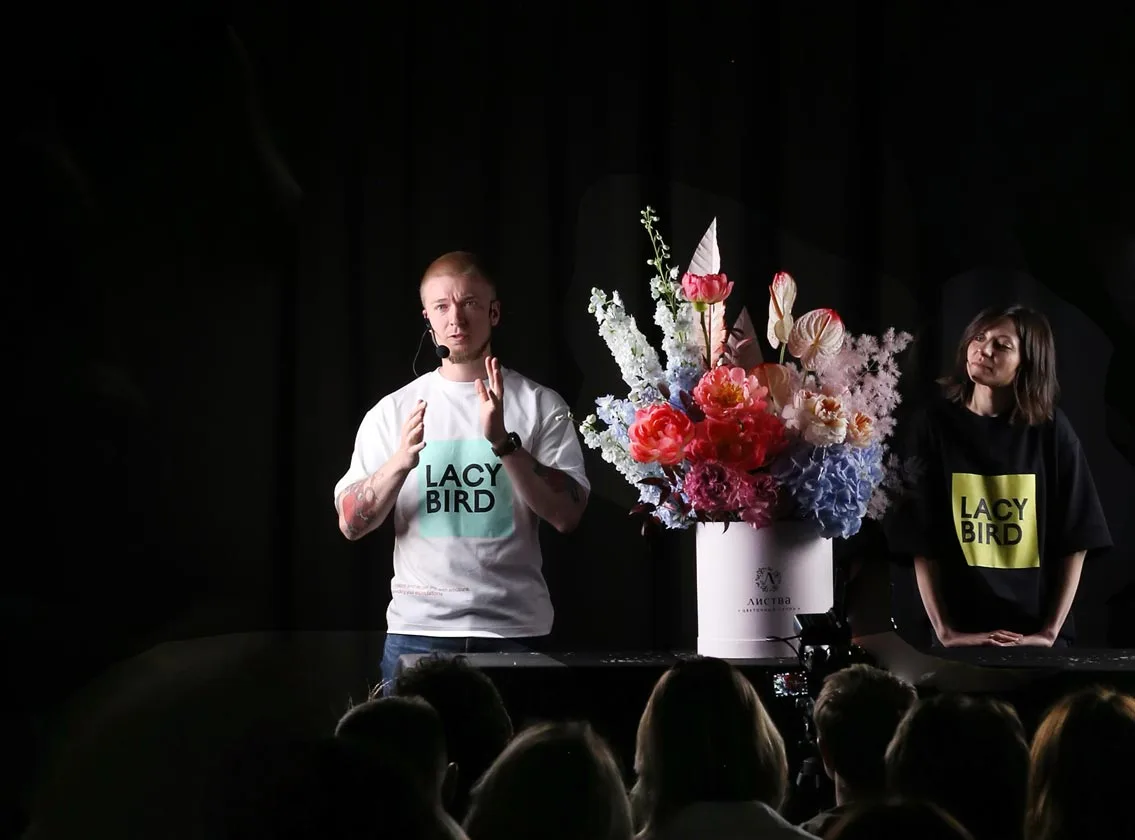
Our masterclasses in Dubai, Amsterdam, Rome, Bucharest, and Kuala Lumpur are the hands-on complement to the online course. Installation work, editorial photography, and portfolio-scale practice that video alone cannot provide.
Most of our professional-level students attend one to two masterclasses per year in addition to the online course.
What our professional alumni do next
- Open or expand their own studio. Roughly 40% of our professional- track alumni run their own business within 2 years of completion.
- Pivot to weddings and events. Common for retail florists moving toward higher-margin work.
- Teach. A growing minority of alumni have opened their own local academies — we support this and often refer regional students to them.
- Farm-to-studio partnerships. Farmer-florist grads often partner with city-based studios for their production supply.
Frequently asked questions
Is this course accredited?
Not externally. See the section above on certification.
Can I skip the fundamentals modules?
Yes — the professional course-content specifically starts at module 3. You can watch modules 1-2 as reference material if you find gaps.
How much do I need to spend on practice flowers?
$500-1,500 across the professional modules, depending on how many wedding-scale builds you attempt. Sourcing from wholesalers rather than retail cuts this by ~40%.
What if I already teach floristry myself?
You're welcome. Roughly 5-8% of our professional-track students are already teaching in their own local studios. Many use our course as a curriculum reference.
Can I bring my own team?
Yes — the course is licensed per-student. For studios training multiple florists, we offer a team-rate for 5+ enrolments. Contact lba@lacybird.com for details.
Enrol
Enrol on academy.lacybird.comRelated
- Modern floral design course — full course overview
- Beginner course — if fundamentals are a gap
- How to become a florist — career paths context
- Florist business plan template — what module 4 teaches, in essay form
- Masterclasses — in-person practice programme