Floristry Classes for Beginners — the Lacy Bird course
Complete-beginner online floristry classes from working florists. No prior experience needed — stem preparation, first hand-tied bouquet, then wedding-scale work over 12 hours of video.
If you've never held a florist's scissors, this is the course we would recommend to you. Complete-beginner floristry, taught by working florists in our studio, taken online in your own time.
Start the courseWhy "beginner" needs a proper course
The most common thing beginners do is try to learn from YouTube. Free video is useful, but it teaches technique in isolation — how to build one specific arrangement, without the underlying system that lets you build any arrangement.
A proper beginner floristry course covers three things YouTube can't:
- Sequenced fundamentals. Conditioning before you touch a stem. Colour theory before you pick flowers. Mechanics before you build. Skip any of these and your first commercial-quality bouquet is 6-12 months away, not 6 weeks.
- Personal feedback. Your first spiral bouquet will have a lean. Someone has to tell you why, or you'll practice the mistake into muscle memory.
- A finish line. "Watching another tutorial" has no completion state. A course does — modules end, a certificate exists, and you know when you've moved from beginner to working.

What the beginner course covers
The full Lacy Bird floral design course starts at zero. If you're a beginner, the first two modules are built specifically for you:
Module 1 · Fundamentals (2h). Stem preparation, conditioning, water, foam-free mechanics (chicken wire, grid taping), colour theory applied to real flowers, and the anatomy of a designed arrangement.
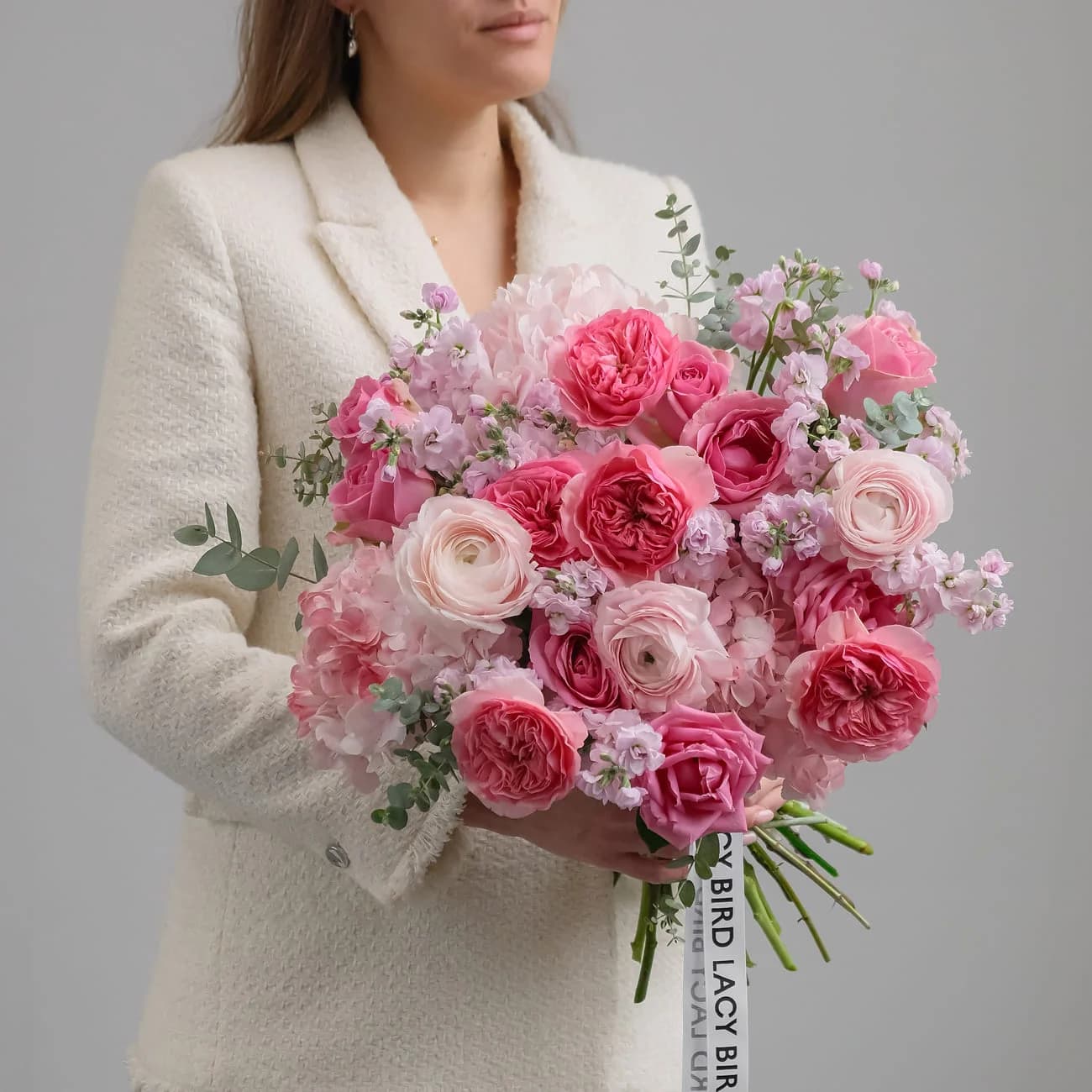
Module 2 · The hand-tied bouquet (3h). Our signature spiral technique across five bouquet variations. By the end of module 2 you can build a 50-stem bouquet in fifteen minutes.
The two later modules (wedding-and-event work, and business fundamentals) are optional for beginners — many students take the first two modules, practice for 3-6 months, then return for the advanced modules once they have working experience.
Who "beginner" means for us
Absolute first-timer. Never bought commercial flowers, never handled a florist's tools, never arranged anything beyond a supermarket bouquet in a home vase.
Home enthusiast. Buys bouquets regularly, has arranged for family events, wants to progress from intuition to system.
Adjacent-skill starter. Has design, photography, or event-planning background — visually literate but new to the specific materials and mechanics of floristry.
Career changer. Coming from a different profession, testing whether floristry is the right direction before committing to a full career transition.
All four fit the beginner track. Working florists updating their aesthetic skip modules 1-2 and start at module 3 or 4.
What you'll need
- Sharp floral scissors and stem strippers — $15-30 total
- Floral tape and wire (24-gauge) — $10-15
- Access to flowers — a nearby supermarket, farmer's market, or wholesale visit
- A workspace — 1×1 metre of counter space, sink access
- A phone or camera — to photograph your work for feedback submission
Total setup: under $50. Ongoing cost of practice: $20-40 per practice session in flowers.
Time commitment
Most beginners complete the first two modules over 6-10 weeks working 3-5 hours per week. That's typically one longer weekend session per week plus a shorter mid-week check-in.
Fastest completion we've seen: 3 weeks. Slowest: 6 months at ~1 hour per week. The pace is entirely yours; the course is not cohort-based.
Cost
The full course (all four modules) is priced as one bundle on academy.lacybird.com. Beginners access all modules — this is deliberate, since progressing to wedding-scale and business modules is a natural next step once fundamentals are solid.
The course carries a 14-day money-back guarantee if it isn't right for you.
What beginner-level completion looks like
By the end of the first two modules you should be able to:
- Build a hand-tied bouquet of 20-40 stems that stands upright on its own base and holds its shape in a vase
- Condition flowers so they last their full commercial vase life (5-10 days depending on species)
- Choose a palette for a specific occasion and match flowers to it
- Wrap a bouquet using at least two of the five professional wrap styles
- Photograph your finished work at a level suitable for a portfolio
Beyond this point, the wedding and business modules extend you toward commercial-professional level.
What our beginner alumni do next
Continue practicing. Most beginners spend 3-6 months practicing after the course, building 30-60 arrangements before feeling professional.
Return for advanced modules. After 6-12 months of practice, the wedding-and-event work module makes sense in a way it wouldn't have during initial learning.
Book an in-person masterclass. For hands-on installation work — arches, ceremony backdrops, editorial photography — that video alone cannot provide.
Start working. Assist at a local flower shop, freelance for photographers, or begin offering flowers to friends and family at real prices. See our essay how to become a florist for the four career paths from here.
Frequently asked questions
Is the course actually beginner-friendly?
Yes — module 1 assumes zero prior experience. If you can follow a recipe and use scissors, you have all the prerequisites.
Do I need any art or design background?
Helpful but not required. About half our beginner students come from creative fields (design, photography, event planning); the other half from completely unrelated backgrounds. Both work.
Can I take just the beginner modules?
Yes, in practice — the four modules are one bundle, but you can stop after module 2. Many students do, then return months or years later for modules 3-4.
How much do the flowers cost per practice session?
$15-25 per session at supermarket / farmer's market pricing. Around $30-40 if you're buying premium flowers (garden roses, ranunculus) from a wholesaler visit. Most students spend $200-500 total on practice flowers across their beginner learning window.
What if I fall behind?
You have lifetime access — no deadline, no cohort, no time pressure. Come back to the course whenever life allows.
Start
Enrol on academy.lacybird.comRelated
- The full floral design course — the complete four-module programme
- How to make a hand-tied bouquet — a free preview of the module 2 signature technique
- How to keep flowers fresh — the care system taught in module 1
- How to become a florist — the career-path essay for post-beginner planning