Wedding floristry
Wedding Centerpieces — the modern guide
Every centerpiece shape working florists actually build for weddings — low compote, tall statement, footed, garland, single-stem — with sizing, budgets, and design principles for each.
Centerpieces do more work than any other floral element at a wedding. They set the visual rhythm of the reception, dictate the aesthetic your guests spend hours looking at, and account for 30-50% of most wedding floral budgets.
This guide covers the six centerpiece shapes we build most often at Lacy Bird, what each is right for, and the sizing/design principles that separate a modern arrangement from a dated one.
The six centerpiece shapes that matter
Modern wedding floristry has settled on six centerpiece shapes. Everything else is a variation.
1 · Low compote
A shallow footed bowl, 30-40 cm across the top, with a loose garden- style arrangement that spreads horizontally. Designed to sit low enough (under 25 cm total height) that guests can see across the table.
Right for: long banquet tables, intimate weddings, garden aesthetic, photography-forward events where guests must interact freely.
Wrong for: ballrooms with high ceilings that visually swallow low arrangements.
Typical stem count: 30-50 stems mixed focals and foliage. Typical budget: $150-350 per centerpiece.
2 · Elevated compote (footed pedestal)
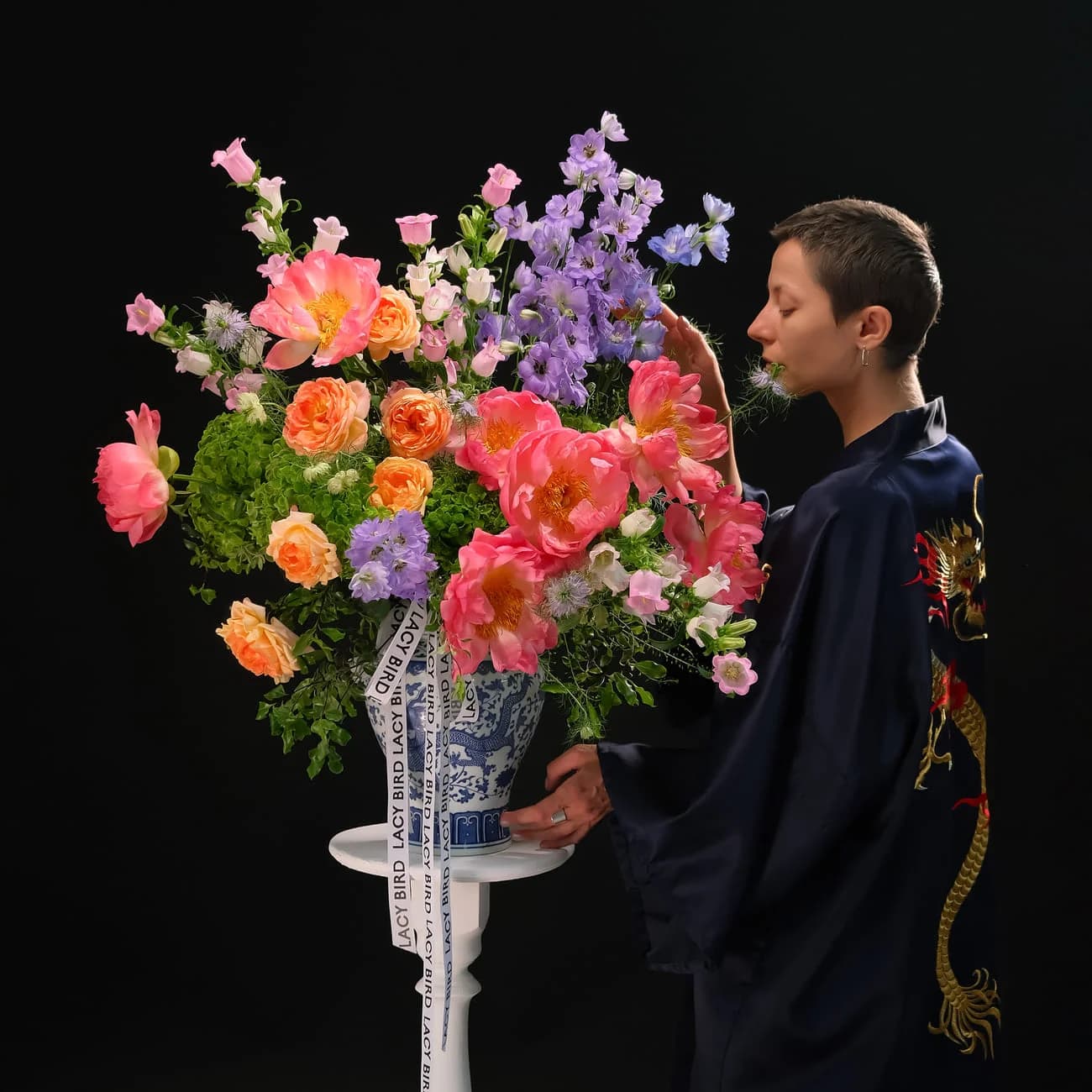
Same compote silhouette but on a tall stand — 40-60 cm off the table. The floral portion drapes down and outward from the elevated base.
Right for: high-ceiling ballrooms, tall spaces that need vertical presence, formal aesthetics.
Wrong for: any table where guests want to talk across.
Typical stem count: 60-100 stems. Typical budget: $400-900 per centerpiece.
3 · Tall arrangement (Eiffel tower / stemmed)
A slender central vase 60-90 cm tall, holding a top arrangement above head height, so guests can talk beneath. The stem is usually clear glass; the arrangement sits at the top.
Right for: formal ballroom weddings, high-drama receptions, photograph-magazine aesthetics.
Wrong for: windy outdoor venues (they fall over), tight-spaced tables (they don't fit).
Typical stem count: 80-140 stems, split between top and lower "skirt" if used. Typical budget: $500-1,500 per centerpiece.
4 · Ground garland (table runner)
A continuous 2-4 meter garland of loose flowers and foliage running down the centerline of a long banquet table. Not one arrangement — one continuous piece.
Right for: long banquet tables (10-30 seats), garden weddings, farm receptions, aesthetics that want continuity rather than punctuation.
Wrong for: round tables, tight venues, tight budgets (garlands are labour-intensive per foot).
Typical density: 60-120 stems per 2 meters. Typical budget: $200-450 per running meter.
5 · Bud vase collection
Multiple small vessels (typically 3-9) each holding 1-3 stems, grouped in a cluster. The alternative to one large arrangement.
Right for: small budgets, small round tables (60-100 cm), modern minimalist aesthetics, weddings with mixed table sizes.
Wrong for: venues expecting single grand pieces; can feel skimpy at formal events.
Typical stem count: 12-24 stems per table cluster. Typical budget: $80-200 per cluster.
6 · Statement single stem
One dramatic stem in a simple vessel — a giant peony, a full anthurium, a branch of blossom, an amaryllis. Editorial and modern.
Right for: design-forward weddings, editorial shoots, minimalist aesthetics, budget-conscious couples who want statement over volume.
Wrong for: traditional weddings where "sparse" reads as under- budgeted.
Typical stem count: 1-5 stems per table. Typical budget: $60-150 per centerpiece.
Sizing and proportion
Getting scale right is what separates centerpieces that look designed from centerpieces that look decorated.
Table size determines vessel size. For 60 cm round tables (6-guest): vessels 25-30 cm wide. For 150 cm long banquet tables: vessels 40-50 cm wide or multiple grouped pieces.
Height rule. Guests must either see over (low, under 25 cm) or under (tall, over 60 cm above the table). Anything between blocks conversation.
Density rule. A centerpiece looks generous when stems are dense but individually visible. Overloaded arrangements read as busy; sparse ones as under-budgeted. Aim for 15-25% of the visual field to be flowers, the rest negative space and foliage.
Palette count. Modern centerpieces use 3-5 flower types plus 2-3 foliage types. More than 7 total varieties starts looking chaotic.
Modern design principles
The last five years have moved centerpiece design in specific directions:
Foam-free construction. Every serious wedding florist has moved away from oasis foam — for environmental reasons and because foam-free arrangements photograph better (no visible green base). Chicken wire, kenzan (Japanese flower pins), and pin-frog mechanics are the current standard.
Asymmetric silhouettes. Perfectly symmetric round arrangements look dated. Modern arrangements lean, cascade, or extend more on one side than the other.
Movement. Modern centerpieces incorporate stems that arch, trail, or extend beyond the container edge — clematis vines, sweetpea, garden- rose sprays, hellebore. Nothing rigid.
Restraint over ornament. Fewer flowers, more considered placement. Empty space around a well-placed peony reads as designed. Filling every gap reads as amateur.
Neutral vessels. Coloured or overly ornate vessels compete with flowers. Clear glass, matte ceramic, or textured stone work; painted or gilded vessels rarely do.
Palette guidance
The palette follows the wedding's overall colour story.
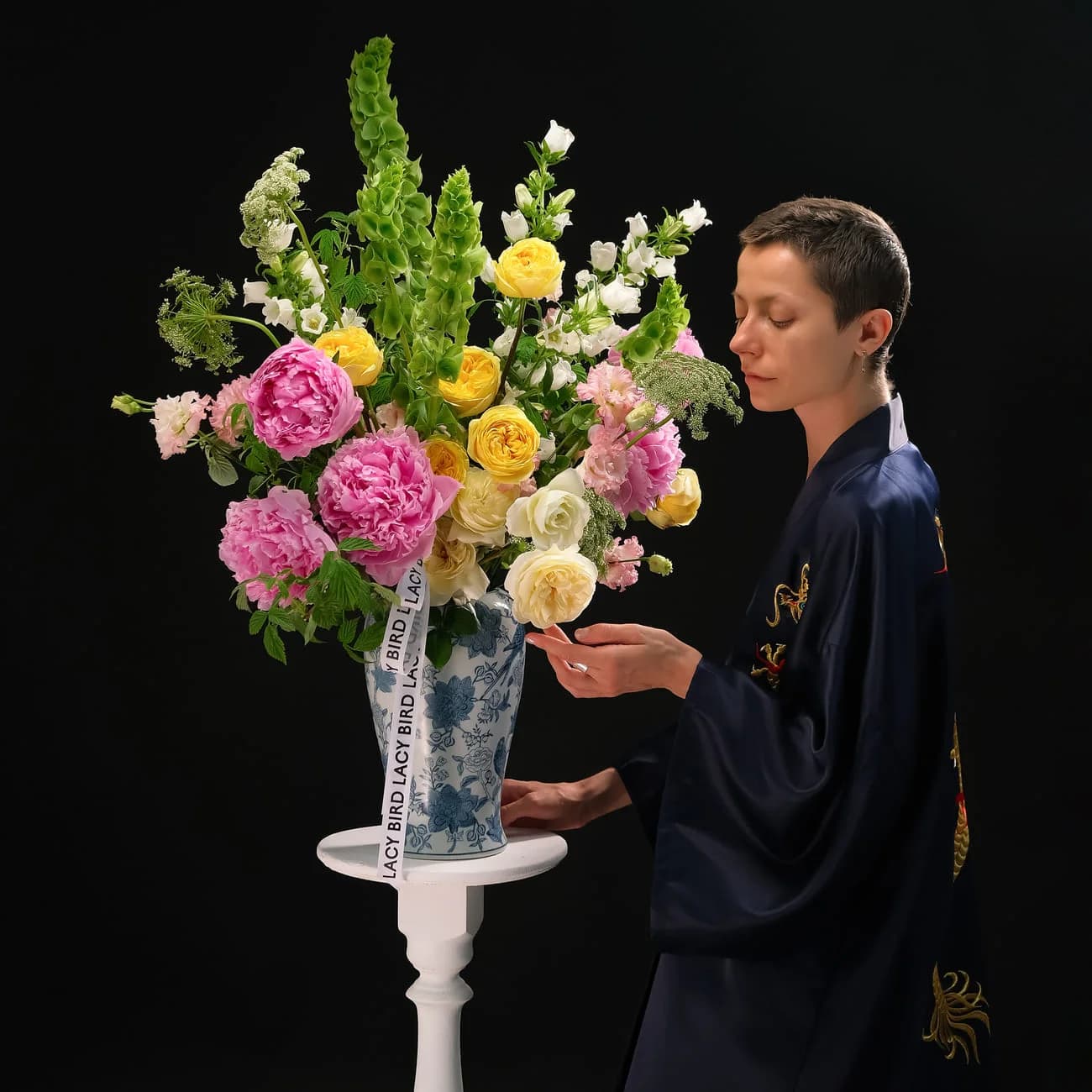
Neutral / cream / blush: garden roses, ranunculus, lisianthus, astilbe, olive foliage, ruscus. Timeless, works in any venue.
Bright / coral / mustard: ranunculus, dahlia (in season), marigold, craspedia, chocolate cosmos. Cheerful, modern.
Moody / burgundy / plum: hellebore, chocolate cosmos, dahlia, scabiosa (deep), ninebark, smoke bush. Editorial, autumn/winter.
All-white: garden roses, peonies, ranunculus, dahlia (white), lisianthus, lily of the valley. Classic, formal, ballroom.
Budget planning
Approximate US market pricing, 2026:
Small wedding (30-50 guests, 5-8 tables):
- Low compote at each table: $150-350 each × 6 = $900-2,100
- Bud vase clusters (alt): $80-200 × 6 = $480-1,200
Medium wedding (80-150 guests, 10-15 tables):
- Mix of low compote + one tall statement per venue area: $2,500-5,500
- Garland runner for the head table: +$400-1,200
Large wedding (200+ guests, 20-30 tables):
- Full mixed centerpiece programme: $8,000-25,000+
- Multiple installation pieces: +$3,000-15,000
Centerpieces typically consume 30-50% of the total floral budget. Ceremony florals (bouquets, boutonnieres, arch, aisle) usually 25-35%, misc (ceremony backdrop, cake, sweetheart table) the rest.
Working with your florist
Bring three things to the centerpiece consultation:
1. Table shape and count. Round vs. rectangular, seats per table, number of tables. This determines vessel scale before any flower is discussed.
2. Venue photos. Ceiling height, lighting, existing decor. A florist designing for a 4-meter-ceiling ballroom vs. a 2.5-meter tent needs different arrangements even with the same palette.
3. Palette samples. Pinterest boards are fine but bring at least one physical swatch — a bridesmaid dress fabric, a favourite ribbon. Screen colours don't match to flower colours.
Discuss:
- Whether all tables have identical centerpieces (traditional) or variations within a theme (modern trend)
- Delivery and setup timing — most florists set 2-4 hours before ceremony/reception
- Contingency for weather (outdoor venues) — indoor backup pieces or weatherproof containers
Common mistakes
Choosing arrangement type before choosing venue. You cannot pick "tall centerpieces" for a low-ceiling barn or "garland runners" for round tables. Venue first, then arrangement type.
Palette confusion. Trying to match too many things — bridesmaid dresses, invitations, linens, flowers — usually produces flowers that don't match anything well. Pick 3-4 palette anchor colours max.
Ignoring the guest experience. Elevated arrangements at 50 cm high are eye-level for seated guests. Guests can't see across. Elevated means over 60 cm; low means under 25 cm.
Underbudgeting. The most common. Wedding centerpieces are labour- and material-heavy. Assume $150 minimum per table for anything above bud vase level.
Choosing style based on Pinterest photos of specific weddings. That Pinterest photo was probably a $2,000-per-centerpiece wedding. Recreating it at $250 is impossible. Discuss actual budgets openly with your florist.
Frequently asked questions
How many centerpieces do we need?
One per table for round tables. For long banquet tables: either one large centerpiece per 2-3 meters, or a continuous garland runner.
Can I combine tall and low centerpieces?
Yes — alternating or clustering by venue area works. Tall pieces anchor the room; low pieces anchor guest tables. Discuss ratio with your florist.
Are DIY wedding centerpieces feasible?
For small weddings (under 30 guests, 3-5 tables), yes if you have adjacent-craft skills. Above that, the flower-handling logistics overwhelm most non-florists. Budget 4-6 hours per centerpiece for a first-timer.
Can we reuse centerpieces from the ceremony at the reception?
Sometimes — if the ceremony pieces are compact enough to be transported and re-placed on reception tables. Discuss with your florist; some studios include this in the plan, others price it separately.
Should we send centerpieces home with guests?
Increasingly yes — a lovely gesture, and centerpieces designed on that principle include vessel-included pricing. Discuss ahead so vessels are chosen for take-home suitability.
What do we do with the centerpieces after the wedding?
Take-home is one option. Donation to nursing homes or hospitals is another (common in the US). Composting is the sustainable default for non-take-home flowers.
How far in advance are centerpieces made?
Assembly happens the day before or morning of the wedding. Materials are ordered 5-14 days ahead depending on flowers used. Some elements (garland base, greenery) may be built 24-48 hours before.
Order wedding centerpieces from Lacy Bird
Our Dubai studio designs and delivers centerpieces for weddings across the UAE and internationally. Full-service — palette consultation, mood boards, delivery, setup, teardown.
Enquire about wedding centerpiecesOr, if you'd like to learn to make them yourself, our floral design course covers wedding centerpieces in the wedding-and-event module.
Related
- Wedding boutonnieres guide
- Peonies season if planning a peony-heavy centerpiece
- Modern floral design principles — the design language behind everything above