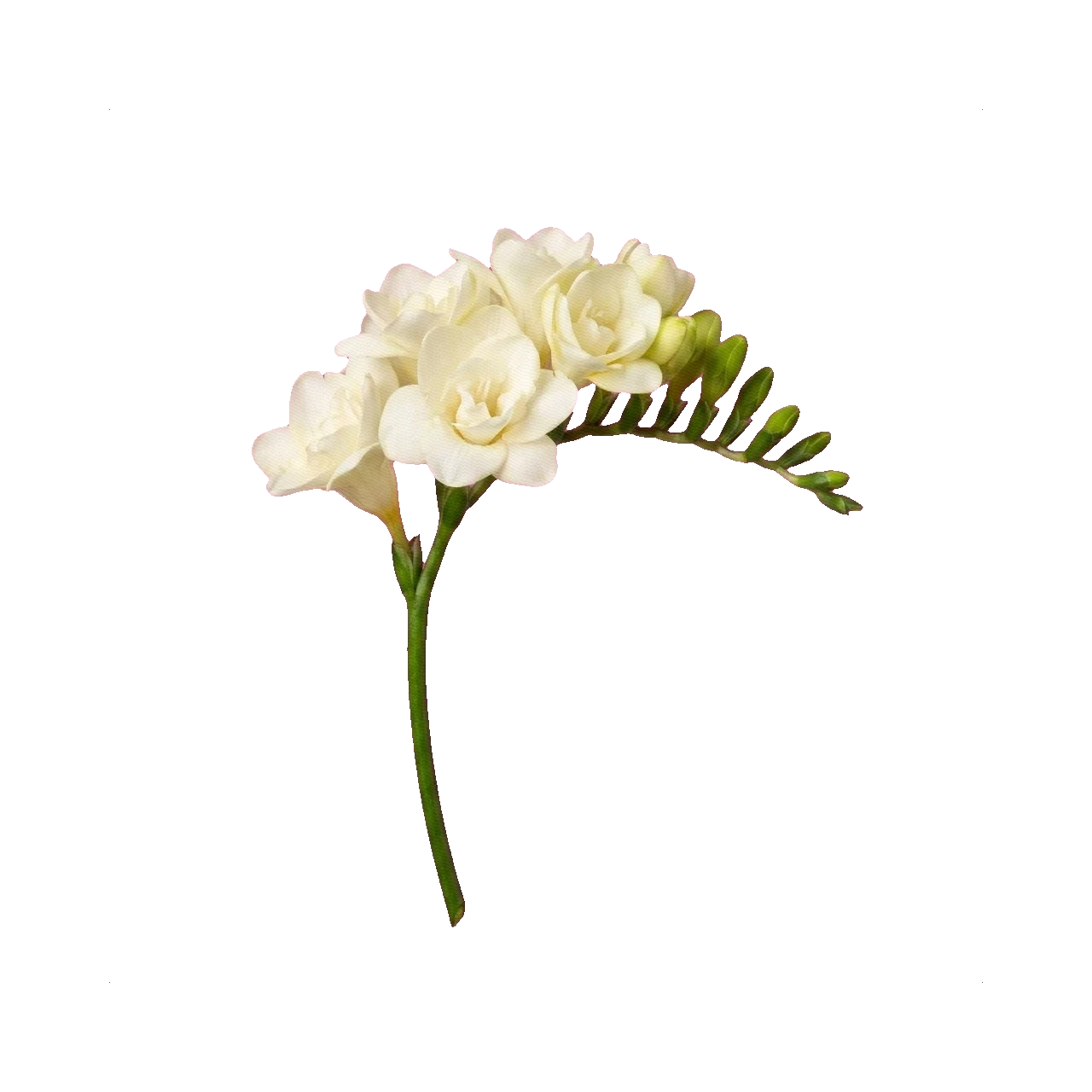
Freesia
Freesia carries an arched stem of 6–10 trumpet-shaped florets that open in sequence over a week. Its fragrance is one of the most pleasant in the floral world — subtle, citrus-honey. Popular in wedding work as a secondary flower and boutonniere staple. Widely available year-round at consistent prices.
| Family | Iridaceae |
|---|---|
| Origin | South Africa; commercially grown Netherlands, Italy |
| Peak season | all year |
| Availability | all year |
| Stem length | 30–50 cm |
| Vase life | 7–12 days |
| Colors | white, cream, yellow, orange, pink, red, lavender, purple |
| Price tier | mid |
Cut on a diagonal, fresh water. Buds continue opening for a week.
- •Delicate fragrance — subtle, not overwhelming like lilies
- •Multiple buds per stem open in sequence along the arched stem
- •Snap off finished flowers to keep the stem clean
- •Refresh water every 3 days
3 named freesia cultivars from the Lacy Bird master catalogue — each a distinct commercial variety.



Entries marked ✦ come from the Acanta master catalogue — the shared database of cut flowers, forms, colours and named varieties that florists and studios build on. The rest are our editorial genus reference. What is Acanta →
 Bouquet Builder — by Lacy Bird
Design the bouquet. See it as a photo.
Botanical reference
- Also known as
- Anomatheca, Nymanina
- Distribution
- Cape Provinces, DR Congo, Eswatini, Free State, Kenya, KwaZulu-Natal, Malawi, Mozambique, Namibia, Northern Provinces
- Cold storage
- 0–1 °C
- Ethylene sensitivity
- low
Open-data sources: GBIF, Wikidata (CC0/CC BY), USDA Agriculture Handbook 66 (public domain)
Frequently asked questions
When is Freesia in season?
Freesia peaks in all year, and florists can usually source it all year. Availability shifts by region and greenhouse supply.
How long does Freesia last in a vase?
Expect 7–12 days with proper conditioning — a clean vase, fresh water every couple of days, flower food, and a cool spot away from ripening fruit and direct heat.
What can I use instead of Freesia?
Good substitutes for Freesia include Sweet pea, Lily of the valley. Match on look, colour and season — our substitute finder ranks the closest alternatives.
What does Freesia symbolise?
Freesia is associated with trust, friendship, innocence.
How do you care for cut Freesia?
Delicate fragrance — subtle, not overwhelming like lilies
Related flowers


Free to quote and cite with attribution and a link back, for non-commercial and editorial use (blogs, journalism, classrooms, research).
Lacy Bird Flower Encyclopedia — “Freesia”. https://lacybird.com/flowers/freesia/<a href="https://lacybird.com/flowers/freesia/">Lacy Bird Flower Encyclopedia — Freesia</a>