How to Cut Flower Stems — the professional method
The correct stem-cutting technique for different flower types, why the angle matters, and the mistakes that shorten vase life.
The single simplest thing you can do to extend cut-flower vase life is cut the stems properly. Most people do it wrong — with kitchen scissors, straight across, in air, once.
Working florists do it four ways better: sharp secateurs, 45° diagonal, under water when possible, and every 2-3 days.
TL;DR. Cut flower stems at 45° with sharp secateurs, under running water if possible, and recut every 2-3 days. Cutting under water prevents air locks in the xylem. Woody stems (roses, hydrangea, lilac) need an additional 2 cm vertical split at the base.
Why the angle matters
A horizontal cut sits flush against the vase bottom. The narrow vascular opening presses against a solid surface, blocking water from entering the xylem vessels.
A 45° cut presents its cut face to open water. Vascular uptake is 20-40% faster. This is the biggest tool-level factor in vase life.
The angle: 45° is standard. Steeper (30°) offers marginal extra surface area but produces fragile stem ends. Shallower (60°) works but offers less benefit.
Why the tools matter
Cut flowers absorb through microscopic vascular vessels (xylem). A clean cut leaves them open. A crushed cut seals them.
- Sharp bypass secateurs: clean cut, full uptake. Standard.
- Dull secateurs: partial crush, 40-60% of full uptake
- Kitchen scissors: significant crush, 30-50% of full uptake. Costs days of vase life
- Steak knife on cutting board: works if sharp; not recommended long-term
- Fingernail pinch: completely crushes. Do not
Testing your secateurs
Cut one throwaway stem. Look at the cut end.
- Clean, glossy cut: tool is sharp
- Rough or torn: dull; sharpen or replace
- Visible crushing: too dull
Sharpen every 6 months of regular use. Replace annually for studio work.
Why cutting under water matters
When a stem is cut in air, air rushes into the xylem vessels at the exposed end. These air bubbles (embolisms) block water uptake for hours after.
Cutting under running water — or plunging into water immediately after a dry cut — prevents air entering.
Two working methods:
- Under-water cut: hold stem under running tap water while cutting. Best result, harder to control.
- Dry cut + immediate plunge: cut in air, submerge within 2-3 seconds. Practical for home.
For studios processing 50+ stems at a time: bulk cutting in air followed by immediate placement in conditioning bucket. Speed matters more than water immersion at scale.
Woody stems — the additional split
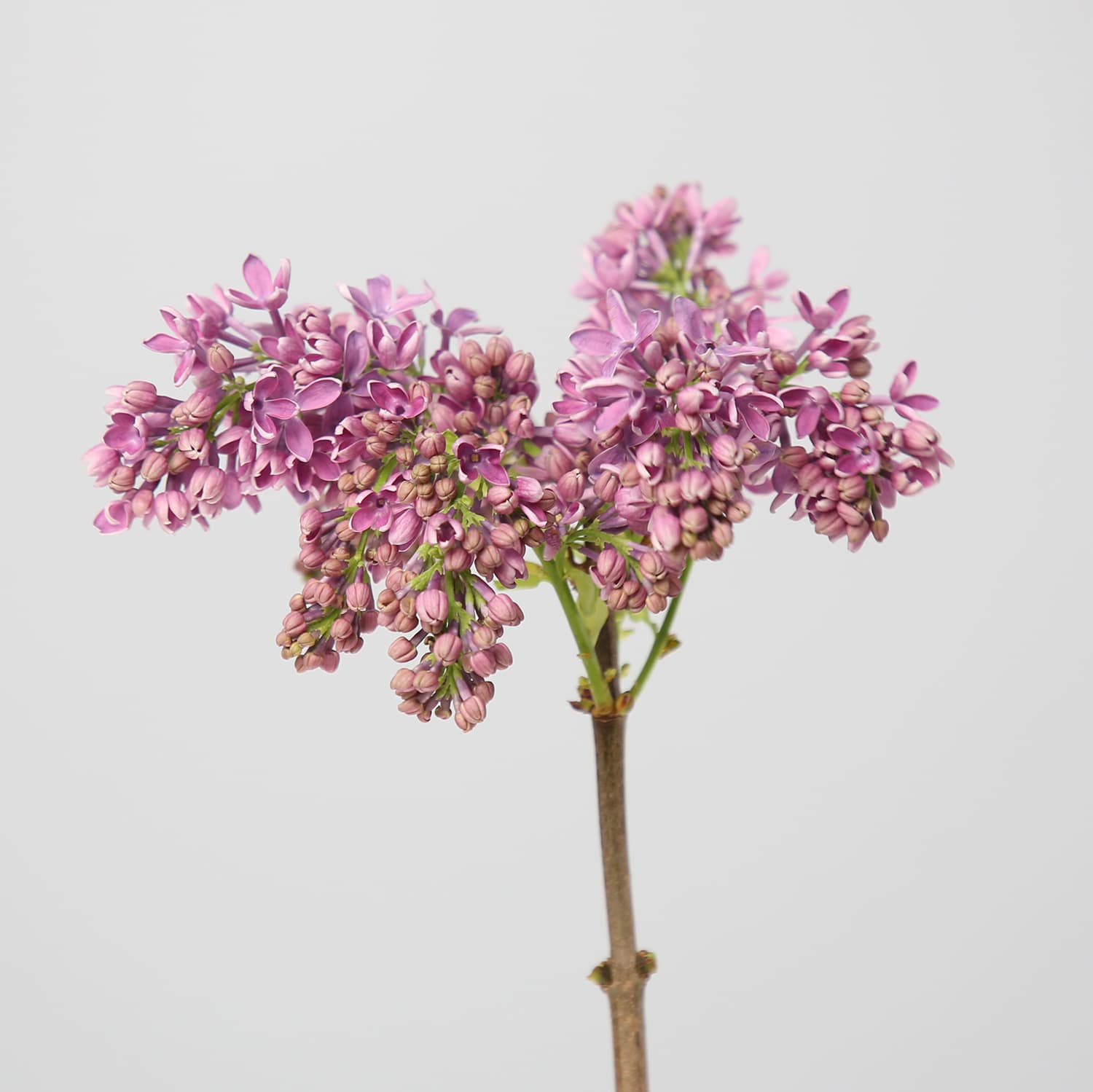
For flowers with woody stem bases — roses, hydrangea, lilac, viburnum, quince — a 45° cut alone isn't enough. The woody outer layer is dense and slow to absorb water.
Split the stem end vertically 2 cm with a sharp knife or the secateur tip.
How to split:
- Make the 45° diagonal cut
- Insert secateur tip or knife into the cut face
- Push down 2 cm to split the woody outer layer
- Do not crush; do not force
The split doubles vascular exposure surface. Woody-stem flowers absorb water 50-70% faster.
For extreme dehydration (badly wilted hydrangea, wilted lilac): add a warm-water immersion — 35-40°C for the first 30 minutes, then transfer to cool.
The boiling method for rescue
For very dehydrated woody flowers, some florists use a brief boiling-water dip:
- Bring water to boil in a small pot
- Cut stem at 45° and split 2 cm
- Dip cut end in boiling water for 3-5 seconds
- Immediately transfer to cool water
This clears air locks aggressively. Rescue technique for badly wilted material — not routine.
The recut schedule
Every 2-3 days: recut 1-2 cm off each stem at the same 45°.
Reasons:
- Stem ends seal as bacteria and callus grow
- Fresh cut restores full vascular exposure
- Coincides with refreshing vase water
When to recut sooner:
- Flowers show early wilting despite full water
- Water has become cloudy
- After transporting the arrangement
When to recut later:
- Fine art / editorial arrangements where stem length must not change
- Very short stems already trimmed to final display height
Stem length for different uses
| Use | Ideal stem length | Notes |
|---|---|---|
| Round hand-tied bouquet | 25-35 cm | Trimmed for bride's grip |
| Elopement / posy | 20-25 cm | Small close-hand format |
| Cascade bouquet | 40-60 cm | Longer for draping |
| Compote centerpiece | 15-25 cm | Cut to vase proportion |
| Tall vase arrangement | 40-70 cm | 1.5× vase height |
| Bud vase / single stem | 15-30 cm | Match vase proportion |
| Boutonniere | 8-15 cm | Trimmed for lapel |
The universal protocol
- Fresh sharp secateurs
- Cut at 45°
- 1-2 cm off the base for arrival cut, 1-2 cm for recut
- Under running water or immediate plunge
- Woody stems get an additional 2 cm split
- Recut every 2-3 days
Follow this and gain 40-70% vase life vs cutting badly.

Cutting for specific occasions
Wedding-morning arrangement
Recut every stem within 60 minutes of assembly, even if conditioned yesterday. Minimises air-lock exposure during the build.
For transport
Recut just before packing. Water tubes on individual stems keep flowers hydrated on the road.
For preservation (drying, resin)
Cut at 45° normally. For hang-drying, cut when flowers are 2-3 days into vase life (not fully open, not aging).
Common cutting mistakes
Cutting straight across. Reduces water uptake 20-40%. Always diagonal.
Dull tools. Kitchen scissors reduce vase life 2-4 days. Get real secateurs.
Cutting once and forgetting. Stem ends seal within 48 hours. Recut every 2-3 days.
Not splitting woody stems. Roses and hydrangea absorb 50-70% faster with the split. Skipping means shorter vase life.
Cutting in warm environments. Warm air accelerates transpiration. Cut in a cool space (under 20°C) when possible.
Not refreshing water after recut. The recut exposes fresh tissue; old water is still bacterial. Refresh at each recut.
Anvil-style pruners. These crush. Bypass-style secateurs cut cleanly.
The cost of good tools
Professional florist secateurs: $30-80. Last 5+ years with care.
Kitchen scissors: $5-15. Cost you 2-4 days of vase life on every arrangement.
For anyone buying flowers monthly or more: real secateurs pay for themselves in the first year.
FAQ
Why do you cut flower stems at an angle?
The 45° diagonal cut exposes more vascular surface than a horizontal cut, increasing water uptake by 20-40%. It prevents the stem end from sitting flush against the vase bottom, which would block water flow. All commercial florists cut at 45°.
Should you cut flower stems under water?
Yes when possible. Cutting under water prevents air entering the xylem vessels — air locks are a main cause of premature wilting. Cut in air and immediately submerge if you can't cut under running water.
How often should you recut stems?
Every 2-3 days for optimal vase life. Cut 1-2 cm off at 45°, refresh water and food. Stem ends seal over time; recutting exposes fresh vascular tissue.
What tools should you use?
Sharp florist secateurs. Kitchen scissors crush stems and reduce water uptake by 30-50%. Bypass secateurs are better than anvil-style. Test by cutting one stem; if crushed or ragged, sharpen or replace.
Related reading: