Wedding Florist Course — the Lacy Bird training
Wedding florist course for working professionals — bridal bouquets, ceremony installations, reception centerpieces, and the production system for full-scale wedding delivery.
The wedding-and-event module of our floral design course is the most-completed part of the curriculum — because wedding floristry is where working florists make the majority of their income.
This page covers what our wedding-focused training includes, who it's for, and the working systems it teaches beyond just "how to build a bridal bouquet."
Enrol on the courseWhy wedding floristry is a separate skill
You can be a working retail florist and never build a wedding. The two skills overlap in materials but diverge in almost everything else:
- Scale. A wedding might have 30-100 stems in a single centerpiece and 15-30 centerpieces across a venue. That's more flowers moving through one event than most retail shops process in a month.
- Timing. Every element of a wedding has to peak within a 8-12 hour window. Nothing can wilt, none of the palette can shift, everything has to travel from studio to venue intact.
- Client stakes. A retail bouquet gone wrong is a $40 refund. A wedding gone wrong is a five-figure crisis.
- Business model. Wedding floristry is project-based, not order- based. Pricing, contracts, cancellation policy, and cash flow work fundamentally differently.
Our wedding-and-event module treats these as one integrated system, not a collection of separate techniques.

What the wedding module covers
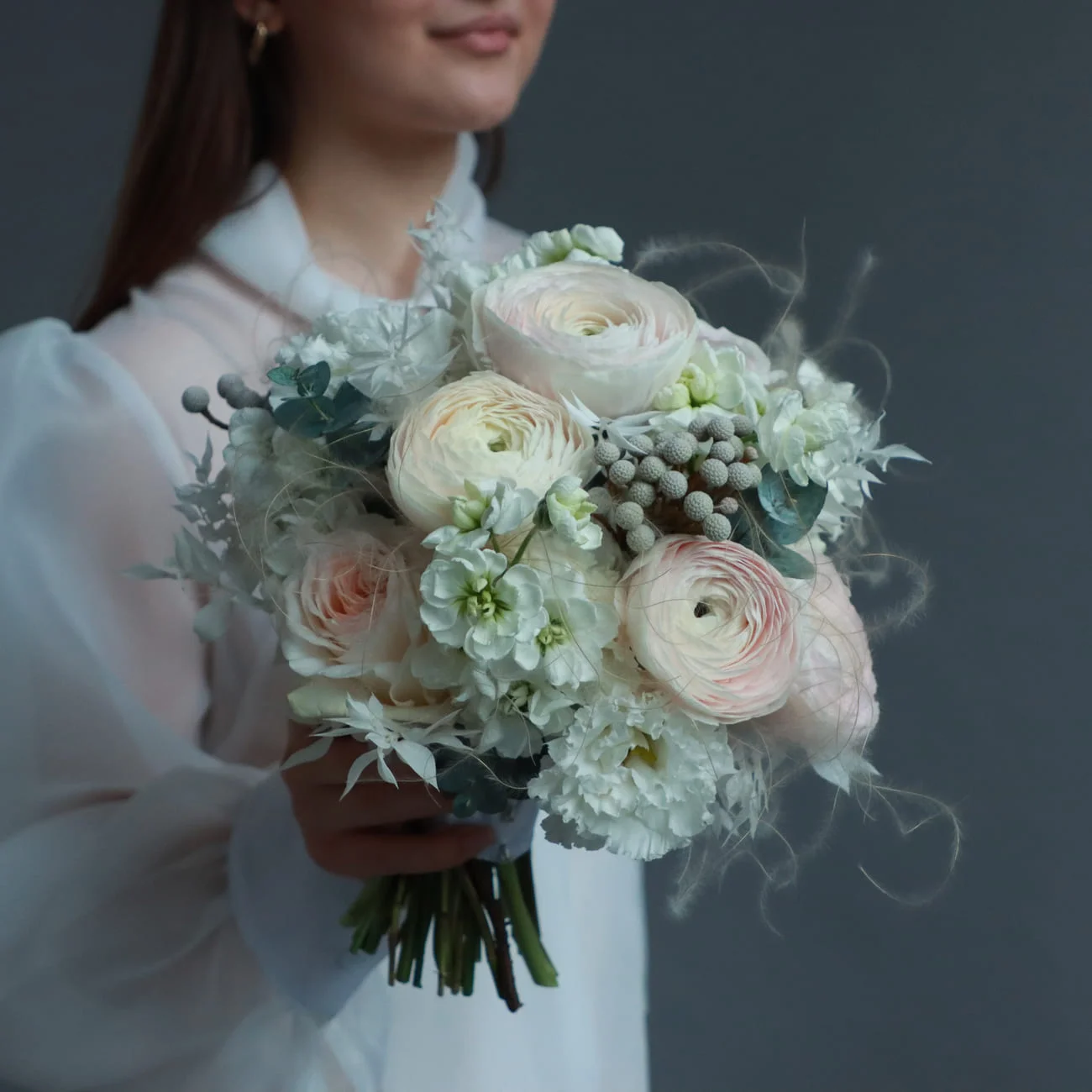
Bridal bouquet mastery. Five bouquet silhouettes in depth — hand- tied round, cascading, structured, compote-style, and asymmetric-modern. Petal count guidance, focal-flower selection, wrapping techniques, magnet vs pin decisions.
Bridesmaid bouquets and family florals. Scaled-down versions of the bridal bouquet, plus boutonnieres and corsages. See our full boutonnieres guide for the level of detail we teach.
Ceremony installations. Arches, chuppahs, altar florals, aisle designs. Includes structural planning — how much mechanical framework you need under the flowers, how to weight-balance an outdoor arch against wind, how to size an installation to the ceiling height of a specific venue.
Reception centerpieces. Six modern shapes covered in our centerpieces guide — low compote, elevated compote, tall arrangement, ground garland, bud vase collection, statement single-stem. Sizing rules, palette guidance, and budget-per-table breakdowns.
Full-venue installation choreography. The production timeline from studio buildout (day before), through delivery (morning of), setup (afternoon), and teardown (post-event). This is the sequence-of-operations knowledge that separates studios that survive wedding season from studios that burn out.
Destination-wedding logistics. Traveling with flowers, sourcing locally at the destination, coordinating with venue-side vendors. Our Dubai studio serves as the case study — we operate as destination-wedding florists for European and American couples flying into the UAE.

Who this fits
Retail florists moving toward events. Wedding floristry pays 2-4x per hour compared to retail. Most florists who last long-term have made this transition by year 3-5.
Freelance stylists adding floristry. Event planners and stylists who want to bring flowers in-house rather than partner out.
Career changers targeting weddings specifically. People starting floristry as a second career often want to skip retail and go directly to project-based wedding work. This is viable if you have the client network — the wedding module gives you the technical foundation.
Studio owners training their team. Team enrolments (contact us for 5+ seat pricing) let a full studio update their wedding-work standards together.
What you'll leave with
- Portfolio pieces at all wedding scales — bridal, ceremony, reception, installation
- A repeatable pricing model that covers your own labour, materials, contingency, and profit
- Supplier contacts for wedding-grade flowers (garden roses, peonies, imported specialty stems)
- Sample contracts, timeline templates, and delivery-day checklists
- Membership in our alumni network — 12,000+ florists including several hundred running their own wedding-focused studios
Format
Delivered as module 3 of the online floral design course. 4 hours of recorded video, plus written recipes, supplier lists, contract templates, and personal feedback on submitted work.
For hands-on installation practice, we run in-person masterclasses in Dubai, Rome, Amsterdam, Bucharest, and Kuala Lumpur. The Event Masterclass designation (Rome and Kuala Lumpur in 2026) means the entire multi-day session focuses on wedding installation practice.
Pricing
The wedding module is included as part of the full course bundle. See modern floral design course for pricing and enrolment.
Time commitment
Working professionals complete the wedding module in 3-5 weeks at 4-6 hours per week. Add ordering time for practice flowers — a wedding-scale practice build costs $200-500 in flowers and takes a full day.
What alumni do with this training
Take on their first wedding. Most students book their first paid wedding within 3-9 months of completing the module. Typical starting package: $2,000-5,000 for a small wedding.
Scale to full-season wedding work. By year 2-3, alumni running wedding studios average 15-30 weddings per season.
Open a destination-wedding practice. Growing subset of alumni target destination weddings specifically — higher margins, more concentrated season, portfolio-friendly work.
Teach. Alumni who've built a strong wedding practice often add teaching (private students, or opening their own regional academy).
Frequently asked questions
How many weddings do I need to have delivered to be professional?
Rough industry benchmark: 10-15 weddings delivered before you can price confidently and predict cost. 25-40 weddings before "wedding florist" is your primary identity rather than an additional service.
What if I've never delivered a wedding?
The module is designed for that case. It walks through the full production system from concept through cleanup, so your first-ever wedding delivery uses the same system your fiftieth will.
Can I take just the wedding module without the rest of the course?
The course is bundled — you get all four modules together. Most working florists focus on module 3 (wedding) and 4 (business) and treat 1-2 as reference.
Do you cover destination weddings specifically?
Yes — destination-wedding logistics are covered within the wedding module. Our Dubai studio operates as a destination-wedding florist, so the case studies are drawn from real client work.
What about very large weddings (300+ guests)?
The module covers up to ~200 guests as the taught case. Above that, the same system applies but with a bigger team — we discuss when to scale staff, when to sub-contract, and when to decline. Truly massive weddings (500+ guests) are their own specialisation.
Can we hire Lacy Bird for our own wedding?
Yes — for weddings in the UAE or as destination florists elsewhere. See /uae/flower-delivery/dubai/ and /weddings/ for services and inquiry paths.
Enrol
Enrol on academy.lacybird.comRelated
- Modern floral design course — full course overview
- Weddings hub — everything we've written on wedding floristry
- Wedding boutonnieres — our longest-form reference guide
- Wedding centerpieces — 6 modern shapes
- Florist business plan — the business side of running a wedding studio
- Masterclasses — hands-on installation practice