Focal Centres — the maths that make a bouquet look more expensive
How professional florists use the rule of thirds and the golden ratio to make budget bouquets read as premium. A working guide to focal centres in commercial floristry.
Every bouquet has focal flowers — the visual anchors that catch the eye first. Where you place them determines whether the bouquet reads as amateur or premium.
Professional florists use two mathematical principles: the rule of thirds and the golden ratio. Both make even budget flowers look expensive.
TL;DR. The focal centre is where the eye lands first in an arrangement. Professional florists position focals using the rule of thirds (2/3 or 1/3 vertical, not centered) and the golden ratio (5:8 focal-to-supporting flower balance). Off- center focal placement makes arrangements read intentional and expensive; centered focals read amateur.
The rule of thirds
Divide any arrangement into thirds vertically and horizontally. Place focal flowers at the intersections.
The four power positions
- Upper-left third
- Upper-right third
- Lower-left third
- Lower-right third
Never dead-center. Centered focals read as amateur or symmetric-mundane. Off-center reads as intentional design.
Which third to choose
- Upper positions: dominant focal draws eye up (elegant, formal, gravity-defying)
- Lower positions: focal grounds the arrangement (organic, garden-style)
For most modern bouquets: upper-third focal placement.
The golden ratio
The ratio 5:8 (approximately 1:1.618) appears in classical art and floral composition.
In practice:
- 5 parts focal flowers : 8 parts supporting flowers
- Focal cluster at 5/8 (61.8%) of the way through the arrangement
- Not dead-center (50%), not extreme edge (100%)
The mathematical proportion feels naturally balanced without being symmetric.
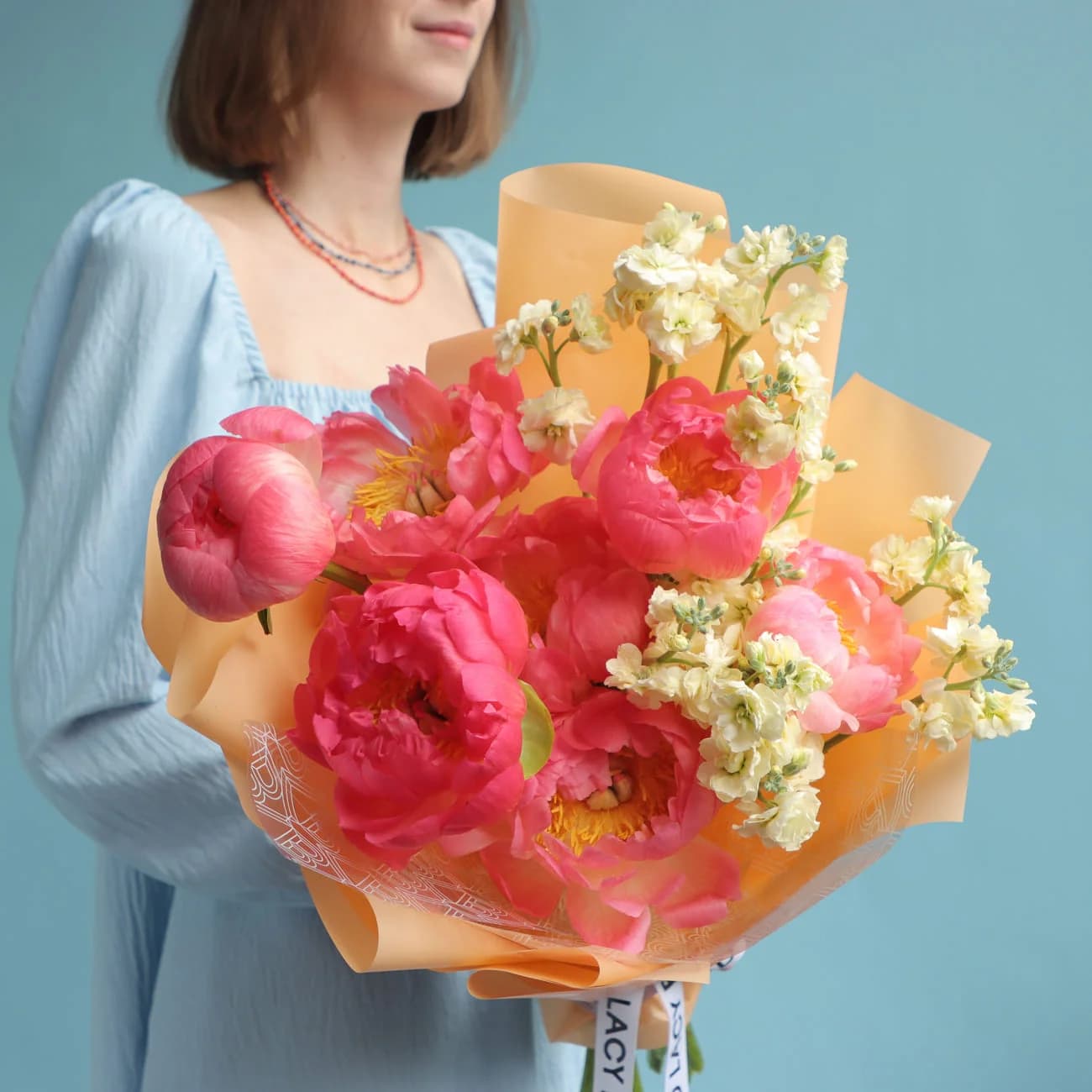
Focal count and arrangement
- 3-5 focal flowers for a mid-size bouquet
- 5-9 focal flowers for a large arrangement
- Group focals in triangle or asymmetric cluster — never line them up
One dominant + supporting
- 1 dominant focal: largest, most saturated color, at prime focal position
- 2-4 supporting focals: slightly smaller, near the dominant
- Together they read as one focal moment
Do not distribute focals evenly across the bouquet. Cluster them.
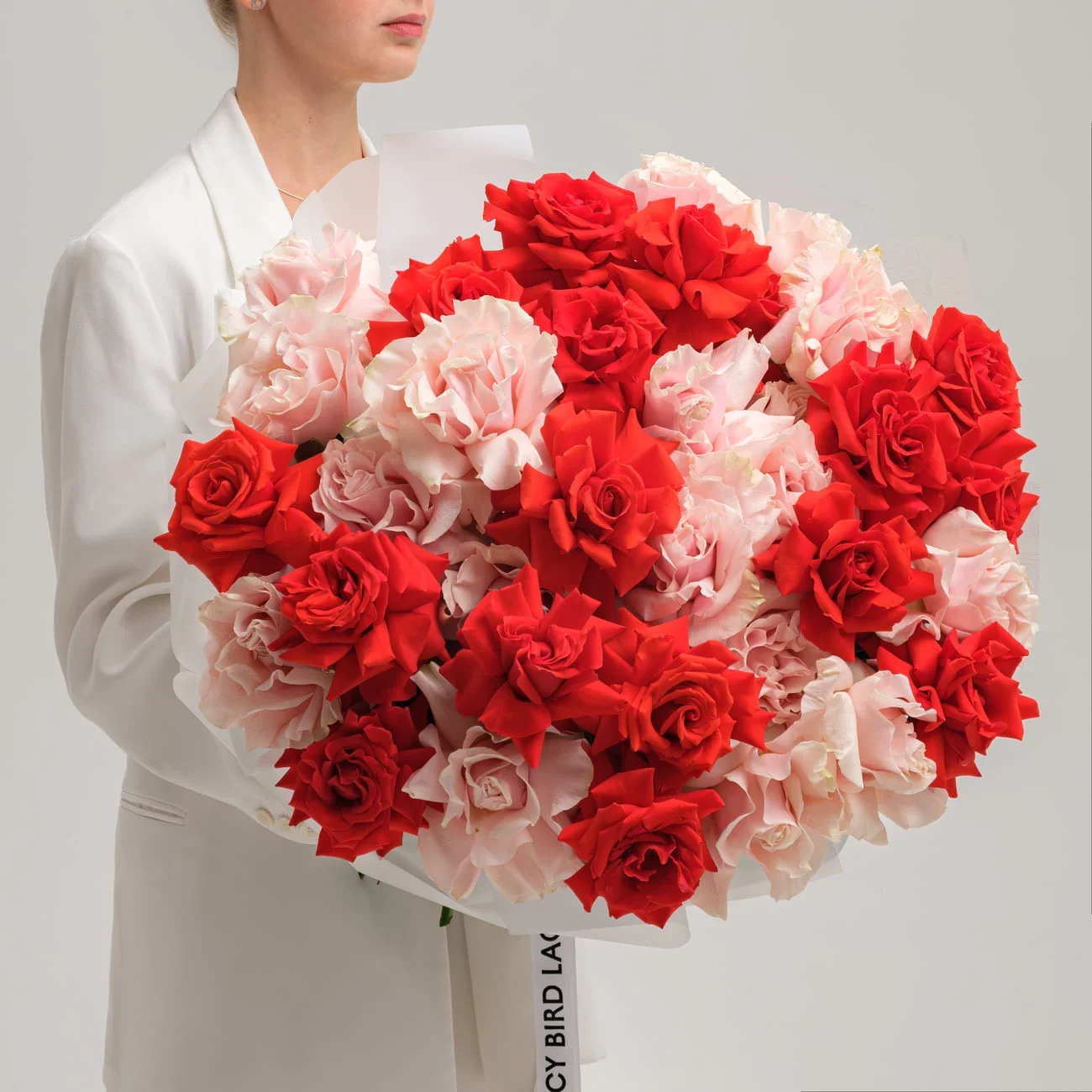
Dominant focal choice
The dominant focal should be:
- Largest bloom in the arrangement
- Most saturated color
- Named premium cultivar (garden rose, peony, dahlia)
- Visually distinct from surrounding flowers
For weddings: garden roses (David Austin Juliet, Keira, Patience) are the modern default dominant focal.
Color composition around the focal
- Focal: primary color (deepest or most saturated)
- 1-2 supporting colors: complementary or analogous
- 1-2 neutral colors: white, cream, sage, green
3-5 colors maximum. More reads chaotic.
Palette discipline is more important than budget for premium appearance.
Negative space
Amateur bouquets fill every gap. Professional bouquets leave intentional negative space.
Around the focal:
- Small amount of negative space frames the focal
- Draws eye directly to the focal
- Reads as intentional and expensive
In the arrangement:
- 15-25% of visible area should be negative space
- Not entirely filled with flowers
- Structural greenery creates negative-space frames
Height variation
Focals should NOT be at identical heights.
- Dominant focal: slightly higher than supporting focals
- Supporting focals: 3-8 cm lower
- Overall focal cluster: 10-15 cm above the surrounding flowers
Height variation reads as garden-picked; identical heights read as retail cookie-cutter.
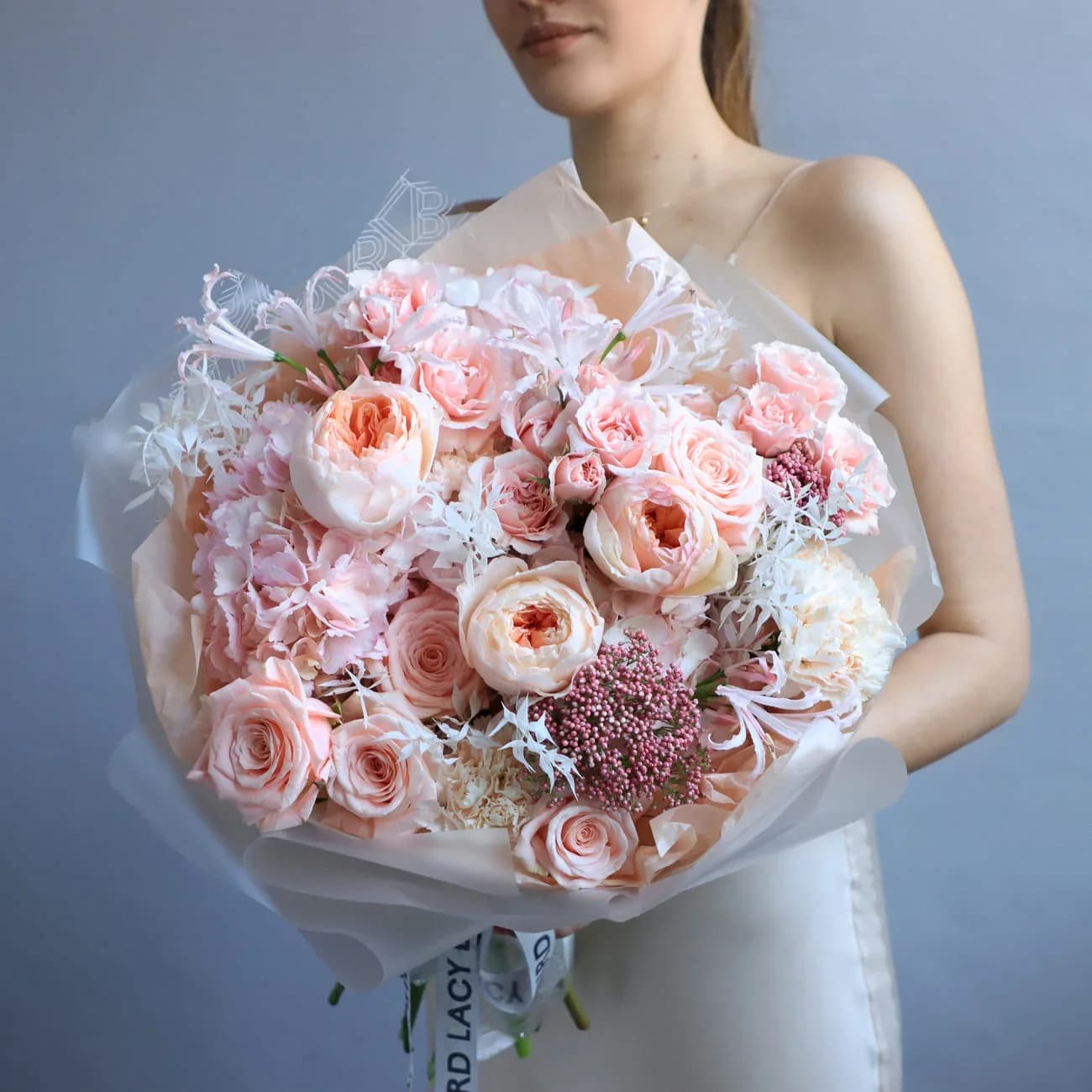
The bouquet examples
Amateur bouquet (avoid)
- Centered focal
- All focals at same height
- Equal color distribution across bouquet
- Filled to edges without negative space
- Standard rose as focal
Professional bouquet (aim for)
- Off-center focal cluster at 2/3 vertical
- Height variation across focals
- 3-color palette with clear hierarchy
- 15-25% intentional negative space
- Named premium cultivar as dominant focal
Same flower count. Different result.
Application to different bouquet types
Round hand-tied bridal
- Off-center focal cluster
- Dominant focal at upper-third of hand grip
- Spiral construction with focal anchoring one side
Cascade bouquet
- Focal at upper connection point
- Cascade extends from focal downward
- Golden ratio: focal at 5/8 of total length
Asymmetric bouquet
- Focal cluster far to one side
- Balance via longer greenery or trailing elements on opposite side
- Modern editorial standard
Centerpiece
- Off-center focal at 2/3 length of arrangement
- Height variation from front to back
- Rule of thirds vertically AND horizontally
Testing your focal placement
- Photograph the bouquet from the eventual viewing angle
- View the photo on your phone
- Where does your eye land first? That should be the focal
- Second glance: does it flow naturally to secondary flowers?
If eye lands on nothing specific: no clear focal. Rebuild.
If eye bounces between multiple focal candidates: too many focals or unclear hierarchy. Consolidate.
Common focal centre mistakes
Centered focal. Reads amateur. Always off-center.
All focals same height. Reads flat. Vary heights.
No color hierarchy. All flowers equal weight. Establish one dominant.
Too many focals. More than 5 dilutes each. Group.
No negative space. Everything filled. Leave 15-25% breathing room.
Cheap dominant flower. Named premium cultivar drives premium perception.
Focal at very edge. Falls off the arrangement. Rule of thirds, not extreme edge.
The 30-second focal check
Before finalizing any arrangement:
- Photograph from viewing angle (5 sec)
- View on phone (5 sec)
- Ask: "Where does my eye land first?" (5 sec)
- Ask: "Is that the focal I intended?" (5 sec)
- Adjust if answer is "no" or "not sure" (10 sec)
Every arrangement improves with this check.
FAQ
What is a focal center?
The visual anchor of an arrangement — the flower or cluster that catches the eye first. Position at 2/3 vertical using rule of thirds. Off-center focals read intentional; centered focals read amateur.
Rule of thirds?
Divide the arrangement into thirds vertically and horizontally. Place focal flowers at the intersections. Never dead-center. Creates visual tension and reads as professionally composed.
How many focal flowers?
3-5 focal flowers for a mid-size bouquet, 5-9 for a large arrangement. Group focals in triangle or asymmetric cluster. Use one dominant focal + 2-4 supporting.
Make my bouquet look more expensive?
Off-center focal placement, single dominant color with supporting neutrals, premium named cultivar as focal, generous negative space around focal moment. The maths matter more than flower budget.
Related reading: