Wedding Flower Arch — planning, cost, design
The wedding flower arch — from simple asymmetric spray to full-cover statement piece. Sizing, structural planning, budgets, and how to design one to actually fit your venue.
The wedding flower arch is the single most-photographed floral element at any ceremony. The couple stands in front of it during vows. Every first-look, first-kiss, and post-ceremony formal shot uses it as the backdrop. It's what guests remember visually.
It's also the most expensive and most technically demanding piece of wedding floristry to build. This is the working florist's guide to wedding arches — planning, budgets, and what to actually ask for.
Types of wedding flower arches
Modern wedding arches divide into four common shapes.
Asymmetric arch. Flowers concentrated in one corner (usually upper-left or upper-right) with the rest of the frame bare or lightly-decorated. Reads modern and editorial. Most cost-effective because it uses fewer flowers.
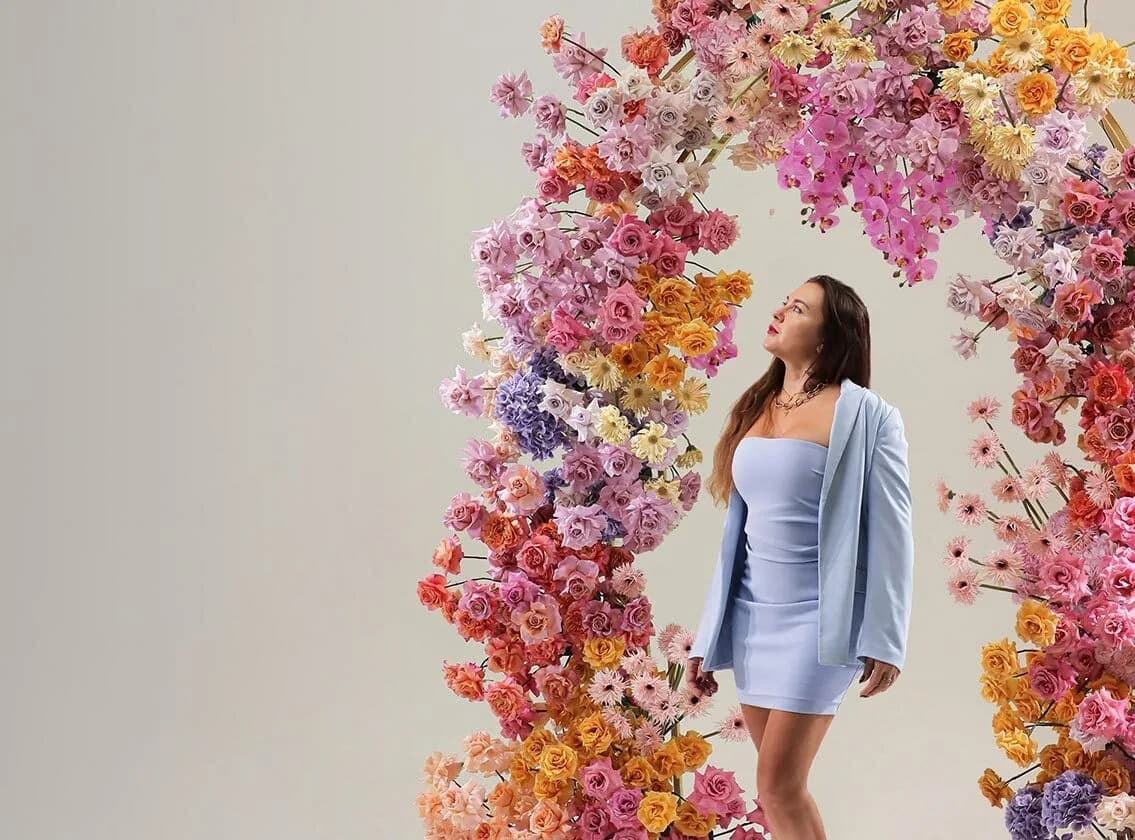
Full-cover arch. Flowers wrap around the entire frame, top and both sides. Reads formal and dramatic. Most expensive because of the sheer material required.
Sparse-symmetric arch. Flowers at three points — top-centre and both lower corners. Reads balanced, traditional-adjacent. Mid-range cost.
Suspended arch (chuppah / canopy). Structure held up by four legs with flowers hanging from the top frame. Traditional in Jewish weddings as a chuppah; also used in destination weddings and outdoor ceremonies.
Round arch (moon gate). Circular frame instead of rectangular. Modern trend, particularly for outdoor and beach weddings.
Sizing the arch
The arch has to fit both the ceremony space and the couple standing in front of it. Common dimensions:
- Small asymmetric — 2.0m tall × 1.8m wide. For intimate ceremonies, garden weddings, elopements.
- Standard — 2.4m tall × 2.2m wide. Most weddings.
- Statement — 2.8m tall × 3.0m wide. Large ballroom or formal ceremonies.
- Round arch — 2.0-2.4m diameter. Independent of the standard proportions.
Rules:
- Height must clear the tallest ceremony participant by 30+ cm. For a 6'2" (188 cm) groom, arch top ≥ 2.2m.
- Width must accommodate couple + officiant + rings/vows without crowding. Typically 1.8-2.2m interior width.
- The frame must weight-balance the flower load. A full-cover arch puts 40-100 kg of floral weight at the top; the frame has to handle it.
Structural considerations
The arch structure sits behind the flowers but determines the reliability of the installation:
Wooden frame. Traditional and beautiful. Heavier and less portable than metal. Requires sanding, sealing, and often painted.
Metal frame (bronze, brass, iron). Standard for modern arches. Lighter, portable, and more consistent. Frame is either painted or left raw depending on aesthetic.
Ghost / acrylic frame. Clear polycarbonate. Invisible against background. Modern minimalist trend.
Live tree branches / driftwood. For organic, natural-aesthetic weddings. Structurally variable — needs on-site adjustment.
Site-built structure. Wooden posts driven into ground for outdoor weddings, decorated with flowers on-site. Cheapest for outdoor use; most labour-intensive.
Mechanical construction (foam-free)
Modern wedding arches are built foam-free. The mechanical options:
Chicken wire wrapped around the frame + water-tube inserts. Standard for most arch work. Chicken wire holds stem structure; water tubes keep individual flowers alive during the ceremony.
Kenzan (Japanese flower pin) pockets. Small kenzan pins embedded at key floral points, hidden by dense foliage.
Stem-by-stem hand-wiring. Time-intensive but produces the finest finish. Used for the most detailed floral concentration points.
Overnight-hydration pre-build. Flowers are conditioned to full hydration, then arranged on the arch 4-6 hours before ceremony. Flowers can go 6-8 hours out of water in temperature-controlled conditions.
What to expect from your florist
Site visit. Before quoting. The florist measures the ceremony space, notes lighting, wind conditions, ceiling height (for indoor), and access. No serious florist quotes an arch without a site visit.
Design proposal. Includes: arch dimensions, flower list, foliage list, structural approach, install and teardown timing, and price.
Load-in and setup. For a full arch, expect 3-6 hours on-site by a team of 2-4 florists. Setup starts 4-6 hours before ceremony start time.
Teardown. After ceremony, before reception starts. Some arches move to the reception space (behind the sweetheart table); others are disassembled and removed.
Budgets
Approximate US market pricing 2026:
- Small asymmetric — $800-2,000
- Standard asymmetric — $2,000-4,500
- Standard sparse-symmetric — $2,500-5,500
- Full-cover standard — $5,000-12,000
- Statement full-cover — $10,000-25,000+
- Round arch — $1,500-8,000 depending on flower density
Frame rental is typically $200-800 additional if using the florist's frame. Site-build wooden posts $400-1,200.
For destination weddings, add travel and freight for the frame — often $500-2,500 extra depending on distance.
Palette and flower choice
Arch florals live at head-height for guests and full-body-height in photos. Consider:
- Foliage carries the arch. 60-70% foliage vs 30-40% focal flowers is the standard modern proportion. Full-flower arches read heavy in photos.
- Focal flowers must survive out-of-water time. Roses, garden roses, hydrangea, hardy-stem specialty flowers. Peonies work if cool; sweet peas and delicate flowers don't survive typical arch conditions.
- Palette must photograph well against the venue. Cream and blush against green foliage reads soft. Burgundy and coral against dark green reads dramatic. Bright colours can compete with venue lighting.
Outdoor vs indoor
Outdoor arch considerations:
- Wind. A 3-meter tall arch with full flowers catches wind like a sail. Weighted base or stake-into-ground fixation is mandatory.
- Direct sun. Flowers wilt in 20+ minutes of direct hot sun. Time the ceremony for shade or accept flower replacement mid-ceremony.
- Rain contingency. What happens if it rains? Indoor backup location needs to be designed for.
Indoor arch considerations:
- Ceiling height. A 2.8m arch under a 3.2m ceiling looks cramped.
- Access. Some venues restrict floral installation to specific setup windows. Confirm venue rules ahead.
- Temperature. Air conditioning near an arch can dehydrate flowers fast. Position matters.
Common mistakes
Under-budgeting. A wedding arch is a large-material installation. Trying to do a "full cover" for $2,000 produces a sparse-looking result. Budget honestly or reduce ambition.
Wrong scale for venue. Ceiling height, aisle width, and background matter. An arch that looks perfect in the florist's photos of past weddings may not fit your specific space.
Skipping the site visit. Every arch quote should be preceded by a florist walking through the ceremony space. Anyone who quotes without that is guessing.
Not planning teardown. The arch has to come down within 2-4 hours after ceremony. Who's doing it, what happens to the frame, whether the flowers get repurposed — all needs to be planned ahead.
Ignoring photography. Discuss with your photographer where the arch sits relative to their planned angles. Positioning affects photos more than any other single decision.
Frequently asked questions
How long before the ceremony does the arch get built?
4-6 hours on-site typically. For large full-cover arches, sometimes the frame is pre-built the day before and only floral work happens on the day.
Can the arch move to the reception?
Yes — this is increasingly common. Discuss during planning; costs an additional $300-1,500 depending on complexity.
Can I keep the flowers after the wedding?
Some, but most arch flowers are already in various states of end-of-life by teardown time. What can be preserved is often taken by guests as take-home stems.
What if the wind is bad on the day?
Discussed and planned during site visit. Options: weighted base, partial-flower design so frame catches less wind, indoor backup location.
Round arch or rectangular?
Rectangular for formal / traditional weddings. Round (moon gate) for modern / outdoor / beach weddings. Both work well; choice is aesthetic rather than functional.
How many people fit under an arch for the ceremony?
Standard 2.2m wide arch accommodates couple + officiant. For larger wedding parties (ring bearer, parents, honour attendants) discuss positioning — often the party stands slightly outside the arch frame during vows, then moves in for photos.
Order
Enquire about your wedding archRelated
- Wedding centerpieces — the reception pieces
- Wedding bouquets hub — the ceremony pieces
- Wedding boutonnieres — the wedding-party florals
- Wedding color palettes — palette breakdown for the arch and beyond
- Book destination weddings in Dubai — our destination-wedding services