Poinsettia: the Christmas plant — choosing, care and meaning
Poinsettia, Mexico's flor de Nochebuena, explained: how to pick a fresh plant, keep it red through January, use it as a cut flower and make it colour again.
 By Daria ShulzenkoPublished
Every December the same plant fills supermarket entrances, office lobbies and grandmothers' windowsills from Mexico City to Moscow. The poinsettia is the world's Christmas plant — and, judged by how many end up bare by New Year, one of its most misunderstood. Here is what it actually is, how to pick a good one and how to keep it red until the holidays are over.
In short. The poinsettia (Euphorbia pulcherrima) is a Mexican shrub that colours up when the nights are long — hence December. The red is bracts, not petals; the closed yellow buds in the centre are your freshness test. Warmth, light, no draughts, no soggy roots.
A Mexican plant with a Christmas name
The poinsettia is native to the Pacific slopes of Mexico and Central America, where it grows as a shrub several metres tall. The Aztecs knew it as cuetlaxóchitl and used it for red dye; after the Spanish conquest, Franciscan friars in the colonial era decorated nativity scenes with it, and the plant took the name it still carries in Mexico: flor de Nochebuena, the Christmas Eve flower.
The English name comes from Joel Roberts Poinsett, the first United States envoy to Mexico, who sent plants home in the 1820s. In the US, 12 December — the day Poinsett died — is National Poinsettia Day. From there the plant went commercial, and today it is grown under glass in almost every country that celebrates Christmas.
Bracts, not petals: why it turns red in December
What looks like a big red flower is a ring of bracts — modified leaves. The true flowers are the small yellow-green beads at the centre, called cyathia. The poinsettia is a short-day plant: the bracts colour only after several weeks of long, uninterrupted nights (around 14 hours of darkness). Growers time this precisely so plants are in full colour for the first week of December.
That biology gives you the best shopping test there is:
- Tight, green or barely yellow centres — a young plant with weeks ahead of it.
- Centres shedding yellow pollen or already dropped — it is at its peak now and will decline sooner.
- Fallen lower leaves, limp stems in wet soil — cold or water damage; leave it on the shelf.
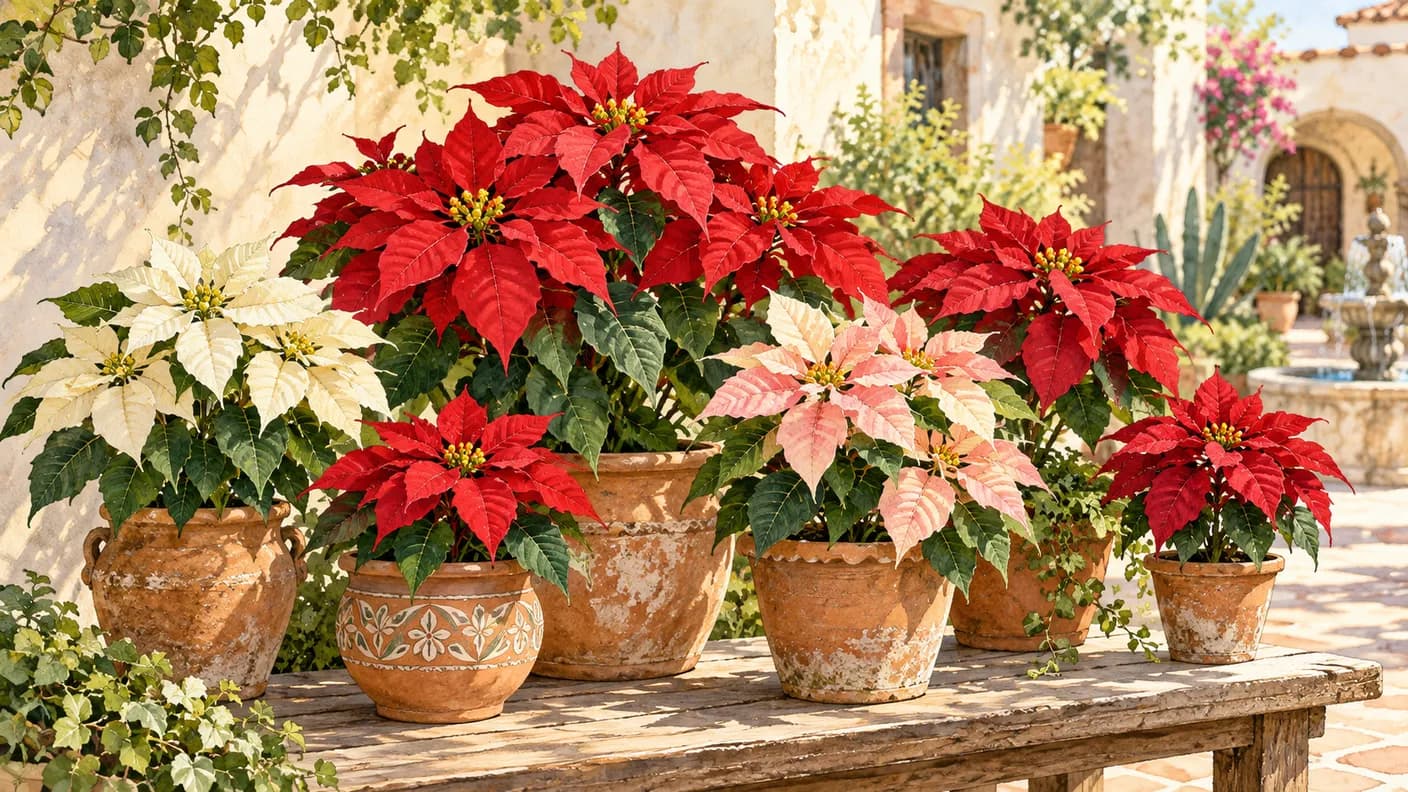
Red is the classic, but white, cream, pink, salmon and marbled varieties are all natural colours. Blue, purple or glittered poinsettias are painted or dyed — fine as decoration, but the paint does not grow with the plant.
Care: the three rules
- Protect the trip home. The poinsettia comes from a frost-free climate. Below 10 °C for as little as ten minutes — an outdoor market stall, the walk to the car — causes leaf drop several days later. Buy from indoor displays and have it wrapped in paper.
- Steady warmth and light. 15–22 °C, bright indirect light, away from both draughty doors and the heat above a radiator. Sudden swings are worse than a slightly cool room.
- Water by touch, not by calendar. Water when the surface of the soil is dry, let it drain and empty the saucer or decorative foil. Roots standing in water rot within days — the most common cause of a bare plant by January.
With this, a good poinsettia stays decorative for six to eight weeks.
Is poinsettia poisonous?
Far less than its reputation. Like all euphorbias it has a milky latex sap that can irritate skin, mouth and stomach: a cat that chews a leaf may drool or vomit, and people with a latex allergy should handle it with gloves. The idea that it is deadly goes back to an unverified story from 1919 and has not held up in later studies. Treat it like any houseplant — out of reach of pets that nibble — rather than banning it from the home.
Poinsettia as a cut flower
Florists use poinsettia bracts in Christmas bouquets, table pieces and wreaths. The trick is the latex: a cut stem bleeds white sap that blocks water uptake. Seal every cut at once — dip the stem end in very hot water for about 15 seconds, or sear it briefly over a flame — then stand the stems in cool water for an hour before arranging. Conditioned like this, cut poinsettia lasts around a week in a cool room. It pairs naturally with the rest of the winter palette: amaryllis, ilex berries, eucalyptus and evergreens.
Making it colour again next year
Most poinsettias are treated as seasonal, but they are perennial shrubs and can be reflowered:
- Spring: cut the stems back by about half and repot.
- Summer: grow it on in a warm, bright place (outdoors once nights stay above about 15 °C); pinch the tips once or twice for a bushier plant.
- From early October: give it about 14 hours of total darkness every night for eight weeks — a box or a dark cupboard from early evening to morning, with no lamp light at all — and bright light by day.
Miss a few nights or let a street lamp in and the bracts stay green: the plant counts the dark precisely. It is a project, not a chore, and a second-year poinsettia is rarely as compact as a nursery one — but it is the same plant that colours the hills of Mexico every winter.
Gifting a poinsettia
A poinsettia is the easy, generous Christmas gift: it works for a host, a colleague, a neighbour or a teacher, and it says "season's greetings" without needing words. Deliver it wrapped, on a mild day if you can, and tell the recipient the one rule that matters — warm and not soggy. For something longer-lived or more sculptural, an amaryllis bulb about to bloom is the natural alternative.
From the Lacy Bird studio. We deliver seasonal flowers across the UAE — see flower delivery in Dubai — and teach floristry, from a first bouquet to running a shop, at the Lacy Bird Academy.
Related reading:
Frequently asked questions
Why is the poinsettia a Christmas flower?
Because it colours up exactly when the nights are longest. The poinsettia is a short-day plant from Mexico: its bracts turn red only after weeks of long nights, so in the northern hemisphere it peaks in December. In Mexico it has been called flor de Nochebuena — the Christmas Eve flower — since Franciscan friars used it in nativity celebrations in the colonial era; the American diplomat Joel Roberts Poinsett brought it to the United States in the 1820s, and 12 December, the day he died, is National Poinsettia Day there.
How do I choose a fresh poinsettia?
Look at the centre, not the red. The true flowers are the small yellow-green buds (cyathia) between the bracts; if they are still tight and show little or no yellow pollen, the plant is young and will hold for weeks. Avoid plants with dropped lower leaves, wilting in moist soil, or that were displayed outdoors or by an automatic door — cold damage shows up only days later.
How do I keep a poinsettia alive through Christmas?
Steady warmth (15–22 °C), bright indirect light, no draughts from doors or windows and no heat blast from a radiator. Water when the top of the soil feels dry and empty the saucer — waterlogged roots kill more poinsettias than anything else. Have it wrapped for the trip home: ten minutes below 10 °C is enough to cause leaf drop.
Is poinsettia poisonous to cats, dogs and children?
Only mildly. The milky latex sap can irritate the mouth, stomach and skin, so a pet that chews it may drool or vomit, and people with latex allergy should wear gloves. Serious poisoning is a myth that traces back to an unverified 1919 story; studies since have found no dangerous dose. Keep it out of reach like any houseplant.
Can you use poinsettia as a cut flower?
Yes — florists do, for Christmas bouquets and table pieces. Cut stems bleed white latex, so seal them immediately: dip the stem end in very hot water for about 15 seconds or sear it briefly over a flame, then stand the stems in cool water. Treated this way the bracts last around a week in a cool room.
 Bouquet Builder — by Lacy Bird
Design the bouquet. See it as a photo.
Arrange real flowers on a canvas, then turn the layout into a photorealistic photo in one tap — with live pricing and a shopping list. 570+ varieties, free to start.
Free plan · no card needed