How to Keep Hydrangeas Fresh: Complete Hydrangea Care
Why cut hydrangeas wilt so fast and how to revive them by submerging the whole head. Conditioning, the alum trick, water regime, and realistic vase life.
Cut hydrangeas are the divas of the summer vase: one hour they are a cloud of blue or blush, the next they have collapsed like a deflated balloon. The frustrating part is that a wilted hydrangea is almost never dead — it is thirsty. Hydrangeas drink through their flower heads as readily as their stems, and once you know that, the "my hydrangeas died overnight" problem becomes one of the most reversible in floristry.
TL;DR. Hydrangeas drink through their petals as much as their woody stems, so a wilted head usually revives by submerging the entire bloom in cool water for 30-60 minutes, then recutting the stem. Expect 5-14 days of vase life with a clean fresh recut, deep cool water, and — if a stem sulks — a pinch of alum on the cut end.
Why hydrangeas wilt so fast
A hydrangea "flower" is actually a dense head of dozens of tiny florets, each with papery sepals, sitting on a thick woody stem. That combination is the whole problem in one sentence: an enormous, high-surface-area bloom that loses water quickly, fed by a stem that seals itself off quickly.
Two things block the woody stem within minutes of cutting. First, air is drawn into the vessels the moment the stem leaves water (the same embolism that troubles roses). Second, hydrangeas exude a sticky sap at the cut that gums up the channels. Between them, the stem's plumbing shuts while the head keeps transpiring — so the bloom outpaces its own supply line and flops.
Understanding this tells you exactly what to do: keep the water path open (fresh recuts, clean water, sometimes alum) and, when the head has already gone soft, rehydrate the petals directly instead of waiting for the stem to catch up.
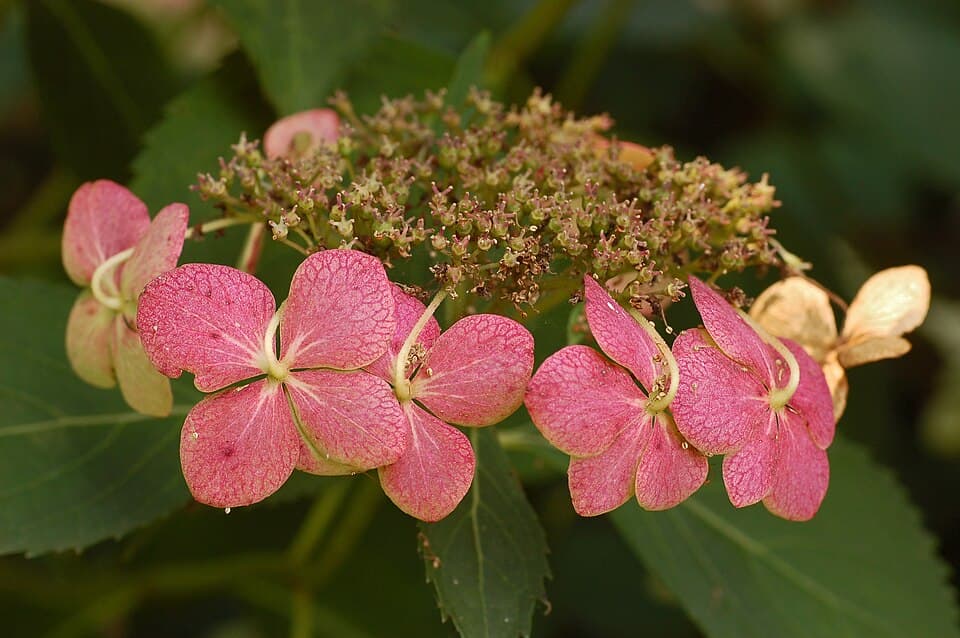
Buying: what a fresh hydrangea looks like
- Firm, cool head that springs back — soft or papery-dry at purchase means it is already dehydrated or very mature.
- Mature blooms last longer. Counter-intuitively, a hydrangea picked young and soft is more prone to permanent wilt than a late-summer bloom whose sepals have thickened. Antique, tinting heads are a feature, not a flaw.
- Clean, pale-cut woody stem — not blackened or slimy.
- No browning at the floret centres, which signals age.
If you can, buy hydrangeas that have been kept in deep water, and get them home fast. Every dry minute counts more for this flower than most.
Conditioning, step by step
We condition hydrangeas the moment they reach the bench:
- Recut 2-3 cm off the stem at a 45° angle, ideally under running water or submerged, so no air is pulled in. A sharp knife or clean secateurs — never crushing scissors.
- Strip all leaves below the waterline. Hydrangea foliage is large and drinks against the flower; removing it sends more water to the head and keeps the vase clean.
- (Optional) split or scrape the woody base a centimetre or two to open more surface for uptake.
- (Optional) the alum trick: dip the very tip of the cut stem into powdered alum before it goes in water. Alum helps dissolve the sap plug on stubborn stems. A light dusting on the cut end only — not the whole stem.
- Deep cool water. Fill the vase two-thirds with fresh cool water. Hydrangeas are heavy drinkers; give them a reservoir.
- Let them have a long first drink in a cool spot before arranging.
Add commercial flower food if you have it — the sugar-and-biocide mix helps as with any flower — but with hydrangeas the water path and volume matter more than the food. See our general conditioning guide for the technique that underlies all of this.
The headline trick: reviving a wilted hydrangea
This is the single most useful thing to know about the flower, so we give it its own section.
When a head has gone soft, do this:
- Recut the stem 2-3 cm at an angle, under water if possible.
- Submerge the entire flower head — the whole bloom, not just the stem — in a bowl, basin, or sink of cool water.
- Wait 30-60 minutes. The sepals absorb water directly and the head slowly firms back up. Do not rush it; leave stubborn heads a full hour.
- Lift, gently shake off excess, and return to a deep vase of fresh cool water.
A hydrangea that fell over on the drive home will very often be standing proud again after a soak. Use cool, never warm water — warm water speeds decay and does not help uptake here. If one head refuses after two soaks, recut and try the alum dip; a truly spent bloom (brown, mushy) will not come back, but a merely wilted one almost always does.

Troubleshooting matrix
| Problem | Likely cause | Fix |
|---|---|---|
| Head flops within hours | Sealed woody stem; air/sap block | Recut under water; submerge head 30-60 min |
| Wilts again after reviving | Stem re-sealed | Recut + alum dip on cut end; deeper water |
| Edges brown and papery | Age or heat/draught | Move to cool spot out of direct sun; recut |
| Water cloudy/smelly fast | Foliage left in water | Strip all lower leaves; wash vase; fresh water |
| Whole bunch soft next morning | Ran dry overnight | Refill vase; it is thirst, not disease |
| Never firms up at all | Bloom was over-mature/damaged | Not recoverable; enjoy briefly |
How long they last — and how to extend it
Realistic vase life is 5-14 days. To land at the top of that range:
- Keep the water deep and clean. Top up daily; hydrangeas drain a vase faster than most flowers.
- Recut every 2-3 days. The woody stem re-seals, so a fresh cut reopens the path.
- Stay cool. Below 22°C, out of direct sun and away from heat vents or ripening fruit. Cool overnight storage genuinely helps — see our note on temperature in the vase-life guide.
- Mist the heads on hot days. Because hydrangeas take water through the sepals, a light spritz supplements the stem.
- Submerge at the first sag rather than waiting — early rescue is easier than late.
Because they can go from soft to dry, hydrangeas also dry beautifully: leave a mature head in a vase with just a few centimetres of water and let it drink dry over a week, and you get a lasting antique bloom for free.
Where hydrangeas fit your arrangement
Hydrangeas are the ultimate mass flower — one head fills the space of a dozen roses — which makes them brilliant value and instantly lush. Learn their botany, colour range, and seasonality on the hydrangea encyclopedia card. Building a design and hydrangeas are out of season or budget? The hydrangea substitute finder suggests mass flowers that read the same way, and the seasonality calendar shows when field-grown heads are at their longest-lasting best (late summer into autumn).
For neighbours that share a vase and a care routine, see our gerbera care guide — the opposite water philosophy, shallow not deep — and the keep-flowers-fresh guide for the daily habits that carry every bouquet to the far end of its range.
From the Lacy Bird studio. We teach floristry hands-on — from a first bouquet to running your own shop — at the Lacy Bird Academy, and we build tools for florists: Bouquet Builder for designing arrangements and Acanta for selling them. In the UAE, we also deliver flowers.
Related reading:
 Bouquet Builder — by Lacy Bird
Design the bouquet. See it as a photo.
Arrange real flowers on a canvas, then turn the layout into a photorealistic photo in one tap — with live pricing and a shopping list. 570+ varieties, free to start.
Free plan · no card needed