How to Keep Carnations Fresh: Complete Carnation Care
Carnations last 10-21 days if you cut between the nodes, keep them away from fruit, and change the water every two days. Full florist care method inside.
Carnations are the flower everyone underrates. Two decades of being the cheap filler in petrol-station bunches gave them a reputation they don't deserve — because a well-grown, well-conditioned carnation is one of the best-value cut flowers in the world: ruffled, faintly clove-scented, and genuinely capable of lasting two to three weeks in a vase. The catch is that they reward one specific piece of knowledge that almost nobody outside the trade knows: where to cut the stem.
TL;DR. Carnations are one of the best-value cut flowers: 10-21 days in the vase when cared for well. The single most important trick is to recut the stem BETWEEN the swollen nodes, never on a node — a stem cut on a joint can't draw water. Keep them away from fruit (they are very ethylene-sensitive) and change the water every two days.
Buying carnations & what fresh looks like
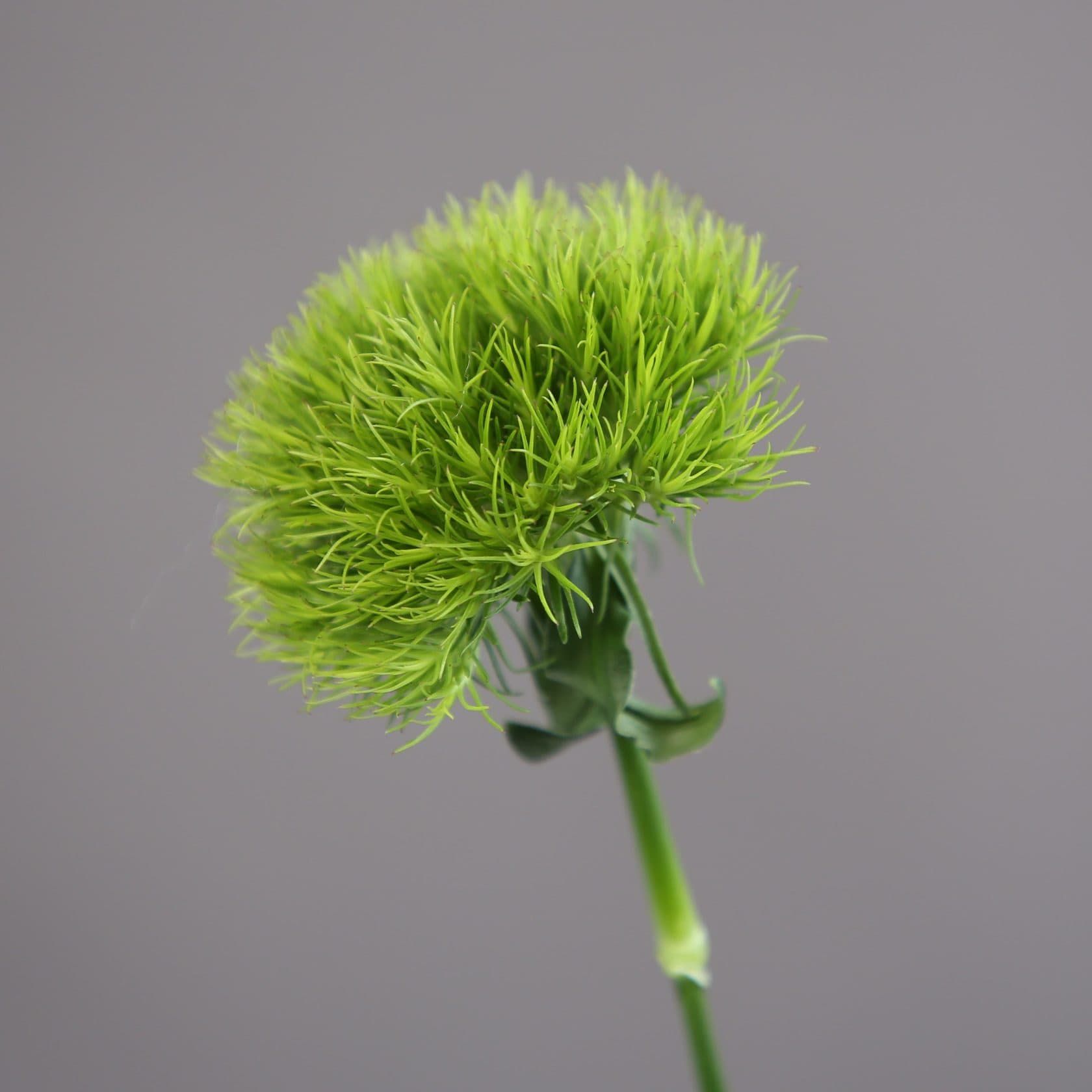
Carnations travel and store better than almost anything, so the ones you buy are rarely truly old — but they may have been chilled a long time. Look for a firm, unsplit calyx (the green cup that holds the petals) and petals that are ruffled and springy rather than soft or browning at the edges. A carnation bought in tight, slightly cupped form will open more fully over its first few days at home, which is exactly what you want.
Give the stems a gentle bend near the top: they should feel firm and slightly woody, never mushy. Sprays (mini or "spray" carnations, with several smaller heads per stem) are just as long-lasting but sit a little lower on the vase-life scale than single big-headed standards.
Conditioning carnations step by step
This is where carnations are different from every other flower on the bench, and it comes down to their botany. A carnation stem is built in segments, with a swollen node (joint) every few centimetres. Those nodes are dense and woody, and a stem cut straight through one struggles to draw water up — which is the number-one reason a healthy carnation wilts within days.
We condition ours like this:
- Fill a clean vase with cool, fresh water and add flower food at the correct dose. Carnations love flower food — see the flower food guide for why the sugar and acidifier matter.
- Find the internode. Run your fingers up the stem to locate the swollen joints. Choose a point midway between two nodes for your cut.
- Recut on a slant, mid-internode, taking off 2-3 cm with a sharp knife or clean secateurs. The angled cut on open stem tissue lets the flower drink freely.
- Strip the lower leaves so nothing sits below the waterline — submerged foliage rots and fouls the water fast.
- Leave to have a long drink in cool water for an hour or two before arranging, if you have time.
That's the whole trick. Everything else is standard good practice — covered in depth in our flower conditioning guide — but the between-the-nodes cut is the one thing carnations demand that other flowers don't.

Keep them away from fruit
Carnations are among the most ethylene-sensitive cut flowers there are. Ethylene is the invisible ripening gas given off by fruit (especially apples, bananas, and tomatoes), by decaying flowers, and by smoke and exhaust. In an ethylene-sensitive flower it triggers "sleepiness": petals curl inward, buds refuse to open, and the whole bloom ages prematurely.
The fix is simple — never put carnations on the kitchen worktop next to the fruit bowl, and pull out any dying blooms promptly so their own ethylene doesn't age the rest. Growers treat commercial carnations with anti-ethylene agents before shipping, but that protection fades, so the home environment still matters.
Common problems & fixes
| Symptom | Likely cause | Fix |
|---|---|---|
| Wilts within 2-3 days | Stem cut on a node | Recut mid-internode, between the joints |
| Petals curl in / won't open | Ethylene exposure | Move away from fruit, smoke, dying flowers |
| Calyx has split, petals spill out | Natural in some large varieties, or over-mature | Cosmetic only; a dab of tape inside the calyx can hold it |
| Water cloudy, stems slimy | Bacteria; leaves left below waterline | Recut, wash vase, strip lower leaves, refresh food |
| Heads droop on the stem | Air lock or dehydration after dry transport | Recut under water, give a deep cool drink for an hour |
| Colour fading fast | Warm room, direct sun | Move somewhere cool and out of direct light |
Most carnation "failures" trace back to just two of these rows — a cut on a node, or a place near the fruit. Rule those two out and a carnation almost always delivers.
How long carnations last & how to extend it
A conditioned carnation runs 10-21 days, with single standards at the top of the range and sprays a little below. That puts them among the best value-per-day cut flowers you can buy — cheaper per day of display than roses, lilies, or almost anything with comparable colour range. Our vase life by species guide ranks them accordingly.
To reach the three-week end:
- Change the water every two days, recutting a fresh slant between the nodes each time and re-dosing flower food.
- Keep the room cool. Below 18°C is ideal; every few degrees cooler buys days. A summer bouquet in a hot kitchen will do half as well as the same flowers in a cool hallway.
- Keep the vase clean. Carnations last long enough that bacteria become the real enemy over week two — a slimy stem end is a spent stem end.
- Remove spent heads. In a mixed bunch or a spray, pinch off any browning flower so it doesn't gas the survivors.
Making them open (or holding them back)
Carnations bought in tight, cupped form will open naturally over two to three days in a warm-ish room. If you want them fuller for an event, place them somewhere a little warmer with good flower food and they'll loosen. To hold them steady — say, to have them at exactly the right stage on a specific day — do the opposite: keep them cool, even refrigerated overnight at 4-8°C, which nearly pauses their development.
Because they are so ethylene-sensitive, resist the temptation to speed them with fruit the way some people do with other flowers. With carnations, fruit does the reverse of opening — it puts them to sleep.
Carnations deserve better than their reputation
If you've written carnations off, it's worth a second look. The modern varieties come in extraordinary colours — antique greens, dusky "Antigua" browns, painterly bicolours — hold their form for weeks, and cost a fraction of the flowers people reach for instead. As a florist, they're one of the most honest recommendations we can make: buy well, cut between the nodes, keep them off the fruit bowl, and they'll outlast almost everything else in the room.
See the full profile in the carnation encyclopedia entry, find stand-in blooms with the carnation substitute finder, and check when they're at their seasonal best on the seasonality calendar.
From the Lacy Bird studio. We teach floristry hands-on — from a first bouquet to running your own shop — at the Lacy Bird Academy, and we build tools for florists: Bouquet Builder for designing arrangements and Acanta for selling them. In the UAE, we also deliver flowers.
Related reading:
 Bouquet Builder — by Lacy Bird
Design the bouquet. See it as a photo.
Arrange real flowers on a canvas, then turn the layout into a photorealistic photo in one tap — with live pricing and a shopping list. 570+ varieties, free to start.
Free plan · no card needed